IDENTITY POLITICS!!!!!1!
[Soundcloud][Website]
[5.75]
Michaela Drapes: On the surface, it’s absolutely puzzling how Bishi’s conflicted identity number, complete with nods to British folk, Indian traditional music and … Morrissey — not to mention moves at smart post-colonial critique, grand songwriting aspirations rooted in palling around with Patrick Wolf and Baby Dee, a gorgeously composed publicity photo, and a St. George’s Day release date — could all go so terribly, terribly wrong. And yet I’m left so very cold. Compositionally, “Albion Voice” is lovely, Bishi knows her popular music history, but the lyric breaks down under her clear-eyed, clear-throated optimism: “Indian skin and Albion voice” turns to ashes in her mouth upon closer investigation. It’s hard to say that something can be too prettily composed to pack a punch, because not everything needs to be ugly to be punk rock, but the lasting legacy of colonialism is slightly bigger and more complicated to merely be “bewildering.”
[4]

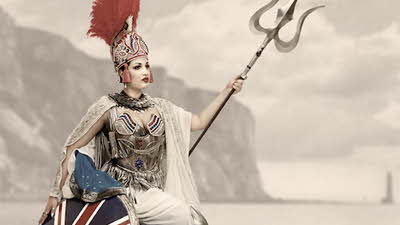
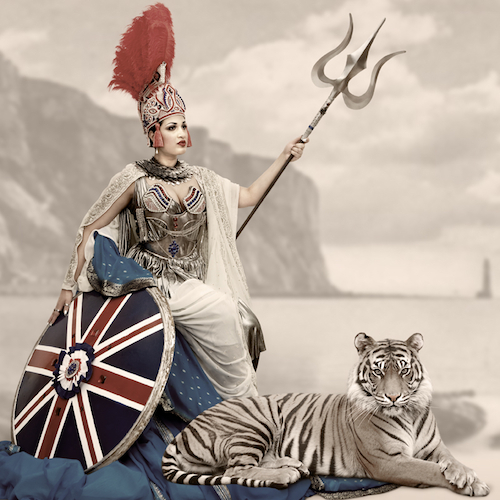
Alex Ostroff: If “Albion Voice” were all I had heard from Bishi, I’m not sure how I would react. It’s a gorgeous folk song, in the tradition of the old English numbers she’s prone to covering as b-sides — “The Three Ravens,” “Flash Company,” “Salisbury Plain,” “Miri It Is,” etc. Lyrically, it takes head on issues of identity, race, culture and space in the British context that have always been implicit in her music — Bollywood disco and flamenco and English folk played on the sitar, written about English clubs and night buses and “two sides of a coin.” Still, “Albion Voice” seems to dress up in stereotypical “English-ness” moreso than usual, and “Let West be a husband and East be a wife” presses a whole bunch of different buttons at once, many of them uncomfortable. Nonetheless, “Albion Voice” feels more complex than a mere uncritical adoption of identity. The cover art depicts Bishi as Queen and Britannia, with a tiger instead of the traditional lion. I’m not sure if it’s reclamation or the creation of space, either, but I’m wary of writing it off until I’ve had more time to absorb the song and its context on Albion Voice. After all, her first single released back in 2009 was ‘One Nation (Under CCTV)‘ an electro/rock rave-up with a video featuring Union Jackrabbits in gimp masks, Bishi done up as a A Clockwork Orange droog, and a focus on government surveillance and militarism. Whatever else this project is, it’s certainly been thought through.
[8]
Jonathan Bogart: I wish I could say her combination of English folk and Indian classical was revelatory, but I’ve listened to a lot of 60s psychedelia. But I suppose every generation needs to cross boundaries when they’re drawn as firmly as these ones are.
[7]
Anthony Easton: She sounds a lot like Vashti Bunyan in places, and sometimes the Indian percussion is very close to hammered dulcimer, and in a very English move she has hired out the arrangements to an American best known for spectacle, so it does what it is supposed to do. The pastoral makes me feel uncomfortable, as do lines like “Indian skin, Albion voice”, or “Let East be the wife”, or “I am Indian in skin, but English in heart.” I cannot say for sure, being very white, and the Anglo-Canadian relationship to mother England being much simpler than the Anglo-Indian, but every time I listen to this fairy cake, I want more robust curries.
[6]
Brad Shoup: Jacking the Incredible String Band and ilk to an astonishing degree, Bishi tries to undo her facile thematic knot by willing the strands into different rooms. “Indian in skin but English of heart” doesn’t sound like a lyric so much as a begrudging Morrissey blurb. I’m fine with her jumping into Technicolor pastoral folk as a way to explore British mythologizing, but to subsume yourself in the chivalry-and-happy-peasant bullshit of “Albion” just to solve a few false dichotomies is awful. To complete the retrogradation, sitar and pan pipes and mouth harp are all combined just as any of a hundred psychedelic folk outfits might’ve ages ago. Perhaps I could excuse the mincing examination as a symptom of economic decline, but lines like “let West be a husband and East be a wife” imply a nauseatingly personal vision.
[1]
Sabina Tang: Bishi underlines her “Albion voice” with an English pastoral folk more formal than that of, say, Laura Marling, who has no equivalent point to prove. Any second- or third-gen immigrant will relate to the lament — or is it triumph? — of resonating to a culture one will not or cannot fully claim, but Bishi’s lingering argument is the courtly beauty of the composition itself, the warp of Western orchestration woven through the woof of sitar ornament.
[7]
Iain Mew: “Albion Voice” gets a lot of mileage out of pushing prim and classicist musical buttons extremely well, especially in the expansive coda, which is a big part of why I love it. There’s something else going alongside the prettiness, though. In a time when a well meaning reality TV programme can happily go out under the title Make Bradford British, so widespread is the assumption that its large South Asian population makes it otherwise, Bishi strongly claiming an English identity as her own as well as an Indian one feels anything but quaint. Even, no, especially, an English identity based on an idyllic fantasy of village greens and spires. In the context I’m choosing to read the implications of her marrying such aspic-preserved ideals to the line “Let West be a husband, let East be a wife” as pointed rather than thoughtless.
[9]
Katherine St Asaph: I don’t doubt Bishi’s sincerity for a minute — with this arrangement, how could anyone? — but I know very well how many people will find this among the only vaguely Indian songs they like, all because of her Albion voice.
[4]