“Okay, now can you turn the ladies’ mics down even further?”
[Video][Website]
[5.50]
Alfred Soto: Been so long since Shelton’s snarled that I figure it’s the missus’ doing. But I can barely hear the missus or her far more interesting cohort. Snarling in abstentia — the boys ’round here call it attitude.
[5]
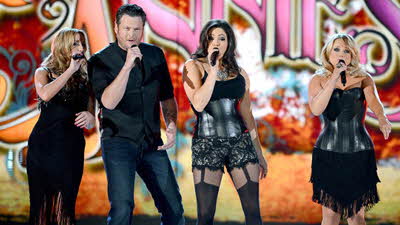
Erick Bieritz: There’s a good sense of space in here, with the filtered red-red-redneck repetition and the Annies providing a lot of depth. But the Annies feel like an afterthought, just singing a bit on a song otherwise crowded with Blake’s bona fides. Is referencing the Dougie in 2013 itself a sort of couched form of signaling that he’s intentionally out of touch with pop culture? Is there so much space in this song because Blake’s country credentials didn’t leave any room for the Annies anywhere near the microphone?
[5]
Patrick St. Michel: Look, this song blows and thematically it’s “country music: all the stereotypes you know.” But that part where Blake Shelton talks about not knowing how to do the Dougie… despite clearly being up on the song, given his references to the lyrics… is so stupid but clever that I have to respect it.
[5]
Katherine St Asaph: Are the lyrics supposed to be making fun of country radio fans? If not, what the hell is this, and why are the verses like “Walk on the Wild Side” and the chorus like a country “Paper Planes”? (Don’t know how to dougie, my ass.) It gets by sheer WTF until Blake spoils the joke with “I’m one of them boys out here.” Since we’re talking bizarro influences: that was hamfisted when it was Vertical Horizon.
[6]
Sabina Tang: To finally answer Paula Cole’s question, the cowboys in her multiverse sector seem to have skipped forward in the timeline. (Lest this note be taken as a zing, I’ll point out that I’m certainly overrating the song out of nostalgia for a particular late 1990s indie pop gestalt — cheesy spoken-word-y white “rap”, gently ironic “country” album interludes, immaculately-produced guitars alternately playing grunge chords or trying to sound like sitars, and so forth. I assume the similarity is unintentional, but you never know. Also, the “chew-tobacco-chew-tobacco-spit” line is hysterical.)
[6]
Jonathan Bogart: Kid Rock circa 2002 called, he wants his etc., etc.
[4]
Brad Shoup: It’s a jolt just to hear one of these shitkickers actually say shit. The joke, of course, is that this is more Beatles than Hank: pop for pop’s sake, a fatty treat that doesn’t apologize for its composition. (Another joke? This wack mashup of Kid Rock, the Doobie Brothers and Rev Run’s Distortion gave us the stereotypical country chorus ne plus ultra.) The road to this goony pleasure is paved with ten thousand Better Than Ezras and Citizen Kings. ChewtobaccochewtobaccochewtobaccoSPIT.
[8]
Anthony Easton: The way Shelton sings “chew tobacco, chew tobacco, chew tobacco, spit” is a hip hop tag. The way he extends “redneck” has a hip hop energy. The grind of the guitar, the sweet little oohings from the Annies and the asides are all ’70s rock. The class signifiers, including the truck, are very much of a certain new money South. (The “chew chew spit” line is the sound of a thousand ad execs gleeful that they have convinced rural working-class boys that chaw is a mark of authenticity. Someone better than me can work out the tension between tobacco and cotton as signals of mobility, for example comparing this to Pride’s “Mississippi Cotton Picking Delta Town.”) The line about the Dougie has an explicit racism that denies the roots of the rest of the track. This might have something more interesting to say about the social and political implications of race and class work in the South than the cack-handed work of LL Cool J and Paisley. (I wonder what Ta-Nehisi Coates would say about this.) All of that needs to be said, but I need to say out loud how much I fucking love Shelton’s voice, and how much of a sucker I am for Shelton’s bullshit-laden good-ol’-boy southern Persona. The cock wants what the cock wants.
[5]