Part deux in “Writers Posing With Jukebox Faves”…
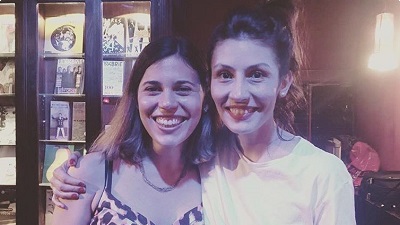
[Video][Website]
[6.71]
Iain Mew: I can hear hints of what I liked so much about her performance last time we covered her — a similar sense of making her way in and out of the flow of the track. This time the song’s just a bit too gentle and low-key for that effect to have much to work with. At least until the final spaghetti western diversion, which I could do with a lot more of.
[5]
Crystal Leww: That outro to “Prometí” sounds like the last part of a Western where the hero races home after saving the day. I do not like Westerns — they are self-important in the most dudely of ways. Thankfully, Daniela Spalla managed to balance that out a bit. She turns this into a melodramatic lite rock bop.
[6]
Micha Cavaseno: There isn’t anything much you can say about this scratchy guitar, mid-20th century pop-ballad style that’s new. When it’s done right it’s fine, and when it’s used to make something seem more than it is, it’s the most tiring slough. “Prometí” is made valid by Spalla’s singing, modest but solid. That said, this arrangement style is a real burden upon her, resulting in cliched retro-cool that dooms this to pretense.
[5]
Ryo Miyauchi: Daniela Spalla’s treacherous tale is a story told countless times in pop to the point it rings cliche. But the classic pop build of the production frames it into something like a timeless allegory. The singer herself delivers it with a patient pace of a drama, the turning points arriving at the right time. Her performance especially befits such a tragedy: present enough in the narrative for it all to feel woeful but with enough of a remove for the story to resonate beyond the narrator.
[6]
Anthony Easton: Tight and short and sweet, with a perfect little chorus, and a lovely sing along quality, this is buoyant in the best sense.
[8]
Juana Giaimo: Daniela Spalla knows how to write songs of a heartbroken lover. In “Prometí,” her grief has a certain sensuality that reminds me of Sandro — and even more so for the retro aesthetic of the music video. She has resentment in her voice, but her desperate yearning still possesses her, giving a genuine feeling to her melodramatic words. In the bridge, she firmly states: “I’m going far away and I won’t come back!”, adding a playful tone that emphasizes her pride — as if she believed for a moment her words — but then she sings: “but desire intervened and it was so strong/that we came out again to look for ourselves.” And there is bitterness in her voice, not only for her complicated love, but for her weakness that made her fall once again, no matter how many promises she made to herself.
[9]
Peter Ryan: Spalla released “Amor Difícil” in August, wherein she stared down an already-toxic love, daring it to get even worse; “Prometí” is its funhouse reflection, the view from just the other side of the long-coming dissolution that doesn’t quite stick. It’s justifiably more downcast — tempo docked a notch, vocal quavering and frayed in places, the chorus an earthbound lament of failures of willpower in place of heady rejections of reason. The triumphant bridge is a fake-out — “no pienso volve-e-e-e-e-e-er…”, only to cede the ending to a return to old habits. But it all fits — nothing in this album cycle suggests illusions of neatness. And as the song says, things are never as easy as people say.
[8]