Show of hands, who was expecting g-funk revivalism?
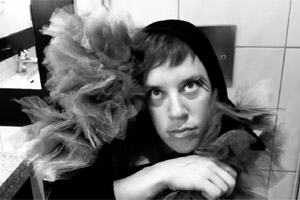
[Video][Website]
[6.70]
Ian Mathers: More than one great writer whose taste I respect has written very highly of Tune-Yards, and in the abstract what she’s doing sounds both interesting and enjoyable. But in practice I can’t stand her voice (yes, she has a “great” voice, but the phrasing and timbre just rub me the wrong way), find her lyrics either clumsy or annoying, and can’t seem to get past production that’s both busy and boring. Again, clearly many people I know get way more out of her than I do, so I hope she keeps doing what she’s doing. And I hope I don’t have to listen to it again any time soon.
[2]
Edward Okulicz: Has the sound of an impromptu parade or protest down the streets, people bashing on anything remotely percussive, a piercing voice their leader, and anyone who couldn’t grab a stick or shout with charisma has to make do with making siren noises. In other words, an incredibly timely record given how much of the world has had a high-profile protest in the last couple of months, but one good enough to deserve its luck; the opening seconds lend itself to a dance as much as a march too.
[7]
Kat Stevens: We live next to a police station in Hackney so we’re used to the sound of sirens at all hours. During this summer’s riots it was weirdly quiet, because the police cars were all busy somewhere else. We made up for it by sticking this on the stereo and going “WEEEEE-OOOO! WEEEEE-OOOO!” at each other.
[10]
Jer Fairall: I’m sure that someone, somewhere has compared the sound of Merrill Garbus’ voice to that of a siren — the literal, bleating, emergency tone rather than the kind typically associated with music, and female vocalists in particular. Perhaps with that in mind, the neatest trick she pulls off amidst this track’s carnival of sounds is having her wordless vocal wails mimic the shrieking signal of a police car or ambulance rushing to the scene of something catastrophic, the “danger” that Garbus keeps warning her subject away from. One wonders if all of this calamity resides solely in our wannabe gangsta’s head, like he’s imagining the shit he could cause if he could ever scale the heights of his pop (anti-) heroes before retreating back inward, letting the lurching mania of this song act it all out for him instead.
[8]
Doug Robertson: Vampire Weekend were a pretty irritating band, so you’d expect a group whose only influence appears to come directly from their deliberately awkward stylings to be similarly annoying, but for some reason this isn’t. Yet. There’s definitely the hint of an itch that’s going to need to be scratched lurking under the surface, and with repeated listens it’s going to get harder and harder to ignore, but right now — and the now is the only moment that ever counts — it sounds excitingly fresh and interestingly gangly, coming across like a natural creation, without sounding like it’s skewed outlook was decided upon weeks in advance.
[7]
Anthony Easton: Mostly because I am a sucker for electronic percussion.
[9]
Alfred Soto: You know how Ultravox sang “I Want to Be a Machine”? Tune-Yards are. The innovation here is to marry verses graced by a reggae melody to a bass synth tap-tapping a rhythm and a vocal that wants nothing else except to be a siren. This isn’t a single — it’s a call to arms.
[8]
Katherine St Asaph: Merrill Garbus is the rare female musician hyped from album one for genius and creativity, not concept and frocks. But Bird-Brains didn’t catch me, and I still feel wrong about that. This time, I was caught; I can live with the pile Garbus tossed or arranged her sounds in for “Gangsta.” But then enter lines like “ain’t never move to my hood,” rastas and gangstas as rhymes, and I suspect Garbus is appropriating more than she thinks. I could be wrong there too; I’ve proven myself quite fallible with this artist. But if some revelation changes my mind, I doubt it’ll be here.
[5]
Brad Shoup: On a very real level, this is an odious piece of whitecraft masquerading as ecstasy. We’re beaten over the skull with sirens: they appear in original form, in the horns, and in the Panda-fied background vocals. And if the verses are supposed to, say, scan as a lament for the marginalized acategoricals, why do they take the form of a reflexive joke: stale signifier-trafficking and authenticity taunts, the sound of someone protesting too loudly over the rhythms they wield? Meanwhile, Lana Del Rey makes mealy-mouthed references to gangstas and ride-or-die chicks, but I can hear those words in the mouths of people who 1) have been marinating in entertainment culture their whole lives and 2) honestly don’t know better. Garbus, however, oozes confidence; there’s very little playfulness or naïveté in her loaded shouts to Jesus and the hood. It’s astounding that otherness still has this kind of pull on blogrock; without it, we’d have an OK energetic number that sounds a little like Gomez’s “Shot Shot”.
[3]
Sally O’Rourke: If a band starts demanding too much from its listeners, my natural inclination is to term it as arrogance and refuse to comply. So when I first encountered Tune-Yards, all sonic futzery, freeform song structures and non-standard capitalization, I greeted the group with arms crossed and eyes narrowed. But as I listened to “Gangsta” more and more, Merrill Garbus’s cheekiness, and her talent at stringing together seemingly random bits of sound into a coherent whole, began to chip away at my defenses. What at first seemed like anti-melodic wankery started to remind me of The Raincoats’ and The Slits’ attempts to create a distinctly female music (i.e., circuitous, not linear), and the African influences suggested an alternate-universe Zap Mama, where Marie Daulne got into indie rock in the ’90s instead of rap. But perhaps what won me over the most about “Gangsta” was its playfulness — it even has aural puns! — and Garbus’s ability to poke fun at herself as the girl who’ll never be a rasta/gangsta, no matter how many world music or hip-hop tropes she incorporates into her songs.
[8]