Alexandra Stan making a Peters and Lee playlist as we speak…
[Video][Website]
[5.62]
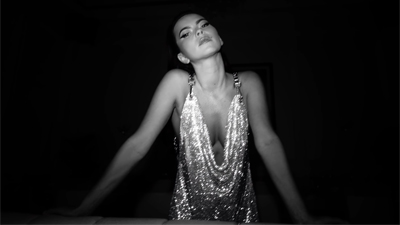
Mark Sinker: I was eight when Mary Hopkin took “There Were the Days” to no.1, and just bowled over by false memory syndrome: I too recalled drinking and laughing in that tavern, the lovely way things had been and were no more. I’d never been and I wanted to go back. The tendrils in Inna’s voice when she drops out of meaning into rococo curlicue at the chorus is somehow an echo here for me of an eerily similar fake-space, like I swapped ghosts with a stranger. Also her silver frock is amazing.
[7]
Danilo Bortoli: The song aims at melancholy but actually lands on a plateau — it hardly develops. Which, I think, is a good description of reminiscing on a past relationship. But I think that was more accident than a conscious decision.
[5]
Scott Mildenhall: Too often, the sound Inna employs here is used without due consideration. A go-to for amateur remixers, its cruder forms can be surprisingly effective, but it’s still satisfying when someone goes to the effort of actually building a song around it. Much of the mood of “Flashbacks” is not reliant on scary vworps; rather, Inna sets out a delicately, thinly layered story to explain them. Pensive and spacious, it makes a little go a long way.
[7]
Nortey Dowuona: The flat drums and beeping synths are muffled to clearly show Inna’s sticking, crackling voice, which crashes against the boot-stomping bass and flat-footed goose down drums with papery claps, barely enough to complete the idea.
[3]
Alfred Soto: Oh boy, did I not expect that transition. The plinking piano intro segues into a thumper with vaguely Balearic undertones, and Inna is one of those vocalists who centers introspection in the middle of a dance floor.
[7]
Edward Okulicz: I’m really not sure what to make of how this moves from pensive and slightly mournful to a bassy, last-minute-at-the-disco stomp that might have suited Rita Ora. Inna does enough to convince in both moods, but it’s the weird, haunting pulse of the piano that keeps the two halves together. There’s something off-putting about that piano, but I’m fairly sure the song would fall apart without it, and it’d be a shame to spoil the melody.
[7]
Juana Giaimo: That piano is so unsettling, it seems to belong to a different song (I actually paused the video to check). I’ve never been a fan of Inna’s generic voice (it’s like a flat Dua Lipa, and though I’m not entirely sure how rich Dua Lipa’s voice is, we’ve listened to her so much over the last couple of years that she’s made us believe she has a unique one). Here she does nothing to either complement or dissipate those eerie vibes going on in the background. I really don’t enjoy this at all.
[2]
Katherine St Asaph: That sonar piano works in the most effortless, obvious way, the aural equivalent of flashback soft-focus — but it does work, especially since they don’t turn it off for the drop.
[7]