How much would you like to withdraw today?
[Video][Website]
[5.00]
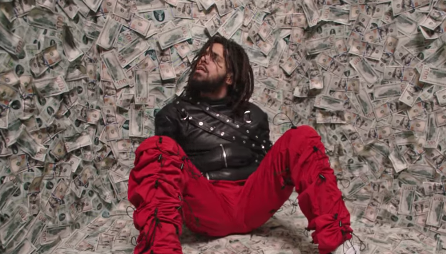
Julian Axelrod: This is a J Cole song, so of course there’s a Serious Message hiding between the bars — in this case, a screed against the dangers of wealth that’s commendable if not relatable. But with the morality play confined to the acid-trip visuals and D’Angelo-aping refrain, Cole allows himself to let loose (at least by his standards) and make a bop. The “count it up” chant is one of his stickiest hooks in years, and the verses are nimble and playful but not too pandering. True to the spirit of the song, Cole gets to have his cake and eat it too.
[7]
Joshua Minsoo Kim: J Cole discusses how he’s “ATM” (Addicted To Money) and how this obsession has left him soulless. The problem is that his rapping is so incredibly forced that it sounds like a reflection of his deeply unprofound lyrics. It’s never good when something serious registers as amateurish parody.
[2]
Nortey Dowuona: Tinkling piano chords waft along behind low, buried drums and the rattling cash machine while Cole pounces on shadows of the De La Soul song he was trying to make running from him, taking Xanax to spite him.
[6]
Iain Mew: As is often the way, the big wheels and quick thrills sound more attractive than any critique of them, couched as that is in so much second guessing and hesitancy. The momentum-killing pauses come off like the audio from an over-extended video version.
[4]
Alfred Soto: As a show of prowess, “ATM” earns at least some of his sanctimony, but from the distorted vocals and piano hook to the triplets he still faces a content problem, despite or because he comes up with the beats himself. What he sells is a show of authenticity as prowess. Maybe I’ll learn to love J’s borrowed trap(pings) as much as I do Change and Tom Petty,
[6]
Will Rivitz: Look, I can’t deny that Cole is a talented musician on all ends of the production pipeline — this song’s beat is a sublimely insubstantial piece of piano-sampling work, and the effortlessness with which he slants a rhyme of “wheels” and “thrills” is only one of many examples of a technical brilliance matched by few today. But when he squanders his considerable musical skill on satire that is somehow both painfully heavy-handed and unimaginably vapid at the same time, there’s only so much that this technical brilliance can do for you. I’m not going to sit here and tell you materialism isn’t worth critiquing, but lines like “money, it give me a hard-on” and “I heard if you chase it it only results in/a hole in your heart/fuck it, I take the whole cake and I won’t leave a portion” are to an intellectually engaging caricature of consumerism as the Borowitz Report is to an intellectually engaging caricature of Congressional politics: smarmily self-satisfied, insultingly dull, and lacking any semblance of introspection.
[2]
Ryo Miyauchi: Eh, at least Jermaine is not trying to pretend he’s above reckless spending or the very pursuit of money. It’s pretty joyless as a pop song despite the technical cadences, though it’s better told as is than some wise crack at hip-hop irony.
[5]
Stephen Eisermann: Money is such a weird thing. I constantly have to remind myself not to live above my means, but damn it’s so hard not to. Everything I want is more expensive or further away and, as J Cole says here, money fixes problems. Still, there aren’t pitfalls: getting too involved in money leads to a nasty addiction that makes you a servant of the financial system. J navigates through these thoughts masterfully on this track, featuring sound effects from money counters, and his flow is commanding as ever. The most interesting part seems to be the way J embraces the obsession here, fully knowing what can come of it. I guess when you’re as good as he is, what is there to really fear?
[8]