Today, we’ll be serving a continental breakfast consisting of a whole horde of our new writers!
[Video][Website]
[5.50]
Alex Clifton: I’m not sure what I expected from a song called “Machinist.” It’s synthy and robotic, with futuristic, Blade Runner vibes about, well, a woman falling in love with a robot. It’s a spacious tune as well; there’s room for the melodic line to grow, rather than cramming everything so the song has no room to breathe. Despite the robo-overtones, there’s something decidedly human about the song, especially in the spoken-word intro: Michelle Zauner’s voice aches for connection with her lover. For me there’s a bit too much Auto-Tune as it drowns out the lyrics, but then again, with a song like this, the words seem less important — her vocal delivery is emotive and keeps you hooked as a listener. The sax solo, on the other hand, drags me out of the futuristic concept and feels out-of-place (is the robot lover a saxophonist? The world may never know). It’s one of those songs where I’m more intrigued by the concept than the execution, but I look forward to seeing what other songs Zauner has up her sleeve.
[6]
Joshua Minsoo Kim: “Machinist” sounds good on paper: a high-concept pop song about the love between a human and machine which uses distinct vocal processing and delivery to tie the whole thing together. It’s a huge and welcome change of pace for Zauner after Psychpomp but I’m not quite convinced by the execution. What are the spoken word bits striving for besides simply playing the human role? Surely not the disaffected cool of Kim Gordon or the nocturnal sensuality of Nina Kraviz. They’re just sort of there, blank, victims to the pursuit of narrative. I’m left wanting to feel the anxiety and urgency of a line like “This could be bliss” but much of the song’s lyrics come off banal and ineffective. Zauner’s melodic flair shines through on the autotuned portions but the warbling is frustratingly awkward at times. I’m so willing to be enraptured by a song this ambitious but it’s just too robotic. It doesn’t help that the sax solo that closes the song makes the whole thing feel like a joke.
[4]
Alfred Soto: A meandering story about falling for a machine, that most modern of situations, this Japanese Breakfast song survives for its sax solo and the vocoderized call and response verses. Keep ’em coming, though.
[6]
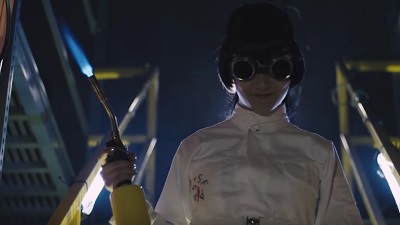
Anaïs Escobar Mathers: I became a sucker for Michelle Zauner as a fellow young adult member of the dead moms club. Her last album was full of energy and raw mid-process emotion with small hints of what she could do when she wasn’t making art from an earnest place of grief. The honesty of Psychopomp drew me in but if not for Zauner’s strong voice both sonically and as a songwriter, her work would have been something I connected with thematically but not musically. “Machinist” is cold, distant, and dancey, all of which are compliments as she expands her scope. Zauner is creating the story (both of this song and the self-directed video) instead of telling the story now and that shift is taking us to falling in love with a robot which I mean, sure why not?
[8]
Tim de Reuse: The airy spoken-word bits are so laughably melodramatic that they could only ever have been saved by an absolutely killer high-energy chorus, but Zauner totally could’ve pulled it off — Psychopomp proved she was capable of tremendous feats of pop exuberance. So why, why, why did she feel the need to smother her sharp, expressive voice with clunky auto-tuning? Furthermore, why is the mix all half-finished and stilted, with the bass and kick drum having a spat in the lower register and all the synths muted and dull in the middle? This isn’t one of the worst returns of the year by any measure (Zauner’s strong knack for catchy melody mercifully shines through even when the delivery mechanism is faulty) but it’s certainly one of the more disappointing ones.
[4]
Eleanor Graham: To me this is Grimes very-very-lite, duotone rather than kaleidoscopic. But I’m frustrated with myself for automatically reading detachment into this kind of song: sheeny, ambient (especially since that word, for me, basically means hookless) dance music that cares little for dancing. Because if that’s what the artist’s brain sounds like, then that’s what it sounds like. Who am I to say that it isn’t raw? Who am I to say it isn’t exactly what the moment felt like? Then again, the fragment of dialogue at the heart of this song glints with such steel that I think it’s supposed to leave me cold.
[4]
Thomas Inskeep: Shuffle-beating faux-new wave that tries hard but never quite gets there.
[4]
Ryo Miyauchi: The vocoder warbling makes me second guess what she really wanted to do here. Her spoken word intro pop gives off a wink that she wanted to go a little more camp here than usual. But she creates such an icy, airtight synth world that being overtly playful with studio toys actually undermines the fine new wave at its core.
[5]
Micha Cavaseno: Y’know, I’m never ever going to be mad about actual vocoders and not talk-boxes or autotune being mistaken for vocoders (though autotune is here being used in a cool compliment here) getting slapped on a track. But there’s something tiring about this land of retro-futurism JBrekkie is playing with here. Even the outro sax has a post-Bowie/Roxy feel that’s super saturated, reminiscent of people infatuated with telling you about how ‘timeless’ cyberpunk feels without informing you of how lame reading Neuromancer actually is in the 21st century. There’s a lot of sense of the future weighed in by old fantasies here, making this mechanical dream as clunky and graceless as the dial-up sounds of a information rush now made quaint.
[5]
Austin Brown: My favorite parts of Japanese Breakfast’s Psychopomp were its asides to synth work and 80s pop (perhaps by way of Carly Rae Jepsen, based on her self-described listening habits during that album’s recording): evidence that Michelle Zauner’s creative impulses stretched beyond the DIY impulses of her time with Little Big League. Here, though, it feels like she’s overshooting–not in the sax or the four-on-the-floor thump, both of which work great, but rather the lyrical sci-fi conceptualism, which blunts her usually sharp songwriting, and the Farrah Abraham/Crystal Castles-style vocal distortion, which blunts her usually sharp vocal personality. It’s great to watch the current crop of indie stars fall in love with machine music–but maybe not at the expense of the straight-to-the-heart aesthetic sensibilities that made them feel so vital in the first place.
[5]
Nortey Dowuona: There’s no groove and the Auto-Tune is out of place. The synths sound watery and thin and the drums are weak and flat. The bass deserves a better song. No groove, no pop, no electro either. Japanese Breakfast is actually a pretty good songwriter, and her (less enhanced) vocals are a little less grating. But the sax solo at the very end is the only interesting part of the song.
[3]
Stephen Eisermann: There’s something oddly romantic about how Michelle Zauner sings about falling in love with a robot — at least I think that’s what she says. The robotic voice harmonizing with her on the chorus, and the way she sings the verses so lovingly, letting her voice trail off and sound dreamy while basically slurring, it’s all extremely romantic. The premise is still weird and the fact that I only understand about thirty percent of what Michelle is saying isn’t ideal, but it’s hard to not to submit to the ethereal-meets-mechanical production. Maybe I relate more to the movie Her than I thought?
[7]
Claire Biddles: Last year’s Japanese Breakfast debut Psychopomp was a realist remembrance of singer-songwriter Michelle Zauner’s late mother; a series of micro-dramas full of human mistakes and empathy, set to scratchy indiepop that recalled the messier ends of The Cure’s discography, and countless 80s British indie groups (maybe because I live in Glasgow, it reminded me of The Pastels the most). For “Machinist”, the first track from upcoming second album Soft Sounds from Another Planet, Zauner stays in the 80s, this time embracing synthy retro futurism — appropriate for a record which explodes her focus from the four walls of her family home to outer space. The song tells the tale of a women falling in love with a machine, in an unspecified place and time, but — like the best science fiction — recognisable as similar to how we live now. Zauner retains her empathy in her transition from the organic to the technological — her voice may be autotuned, but her particular emotional insight is on show through the (digital) cracks. The song’s conceit is a sci-fi cliché, but it works because Zauner holds on to the intimacy that was all over her first record: She tells fantasy fairy tales in the same tone as family confessionals, and that’s what makes “Machinist” relatable. Maybe it’s dramatic, but I recognise the way she whispers “do you trust me? can you feel it?” — hopeful, into an empty space — from the subtext of all the text messages I’ve ever sent to all the crushes I’ve ever had. A robot’s just another thing that won’t love you back. The song ends with a quintessential 80s futurist signifier — a driving sax solo — then it just finishes, like an astronaut sucked out of an airlock, leaving you alone.
[9]
Leah Isobel: Michelle Zauner is very good at creating atmosphere — “Machinist” has a gorgeous, hazy, rain-streaked sound. The drums add urgency and the spoken parts, which could easily come off as corny, instead only add to the song’s mystery. Even the saxophone solo works, its ecstasy enhanced by how it suddenly cuts off instead of trying to preserve something fragmentary. I’ve disappeared into love before, and I can’t say I enjoyed the experience that much; “Machinist” doesn’t forget the possibility of danger, but it reminds me of the pleasure too. There’s a thrill in not knowing what’s hiding in the fog.
[7]