So she knows Swedish now, then? ARTY…
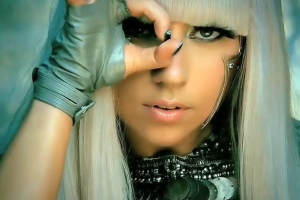
[Video][Website]
[5.61]
Martin Kavka: The more I listen to Lady GaGa, the more I become convinced that she really is as canny and clever as she says she is. This song appears at first glance to be a stalker anthem. But wait, there’s a twist! The ’80s-power-ballad production makes it far sweeter and apparently innocuous, as if the lyric were “Dear Rockstar who doesn’t know my name, please take my breath away.” That’s not extra creepy, because unlike most stalker anthems, the narrator here knows that the rockstar doesn’t love her. But wait, there’s a second twist! Here, the groupie tells the rockstar that she can make him famous. She really doesn’t need him for anything. In fact, she doesn’t seem to love him at all. But wait, there’s a third twist! The middle eight completely leaves the story behind; it’s set in GaGa’s studio, and ends with “We’re plastic but we still have fun!” What does this have to do with anything? Who knows, but it sure saps the song of anything frightening. Whether that makes her music, in the end, nihilist is something I still haven’t decided. But I can’t help but respect — and perhaps love — someone who so decisively asserts that we all live in her world.
[7]
Dave Moore: The video/music split here exemplifies why Lady Gaga pisses so many people off, I think. The video’s got it all — pseudo art cinema intro, “edgy” dance routine on crutches, brief shots of anonymous dead supermodels, photo flash jump cuts (is it a camera…OR A GUN???!!!). Thing is, this song is not actually about anything particularly interesting. And to that end, it’s quite good — a resolutely silly early-Madonna melody in the verses and a low-flying liquid chorus. So for once I’m going to ignore every impulse to punish her for contextual pretensions and just give this stupid thing the “7” it deserves.
[7]
Alex Ostroff: I’m not even sure how to process GaGa anymore. Love the ambition, hate the result. She’s most palatable when she’s flaunting the total pop kitsch of her first two singles and playing to the cheap seats in gay clubs — there’s plenty more trashy electro on The Fame that she could have released. Instead, a ballad that equates unrequited love with the celebrity-paparazzo relationship, and turns GaGa into a creepy stalker. If purposeful, it’s a nice touch, but intent, idiocy and happy accidents are muddled where GaGa is concerned.
[6]
Keane Tzong: Tinny vocal samples in the chorus and a squelchy, almost-interesting beat provide a nice aura of super-budget glamour- the most successful Lady Gaga’s ever been in evoking any sense of time or place, I’d venture to say. Then around 2:30 she stops singing and starts yelling and it all goes to shit again. Shame.
[6]
Chuck Eddy: Long ago, and oh so far away, she fell in love with you before the second show. But if you want to know how she really feels, get the cameras rolling, just get the action going… Sad, pretty melody; ominous thump below; no less emotion in the singing than, say, Neil Tennant has usually managed. Not that smart people still blindsided by her backstory will ever notice.
[8]
Michaelangelo Matos: This is literally the first time I’ve heard her, and it’s revelatory for a couple reasons. 1) This is what she sounds like? Failed synth-pop? (The chorus is precisely where it fails, even if you want to grant it the hidden-in-plain-view daddy kink of “Papa Paparazzi.”) Wow. All that furor over another whiny chick who can’t hit the notes? 2) This helps explain the sudden electroclash revival. 3) This is like a bad Media Studies term paper on irony.
[3]
Alfred Soto: Other critics will adduce her groupie fantasies as proof of the Lady’s post-feminism; the arrangements and melodies come out of the Katy and Linda Perry school of passive-aggression, though, and the middle eight is Gwen Stefani 2004. Like “Waking Up In Vegas,” maybe the use of unexpected metaphors makes the women that much more cartoonish.
[4]
Rodney J. Greene: Lady GaGa finally finds some synth patches that pop and roll more than they assault, and commits to not doing anything embarrassing beyond your usual egotist pop diva standards. She saddles this song with yet another hook that doesn’t quite work, but any step in the right direction is gladly accepted.
[5]
Hillary Brown: That chorus has quite a nice hook, but it takes a while to get there, and the bits that aren’t the chorus are slower and, you know, not the chorus.
[6]
Ian Mathers: I haven’t liked any of her singles before, but the chorus here is brilliant – great melody, and strangely moving. The narrative is terribly confused, especially if you watch the video, but I’m beginning to think that’s part of her genius; for better or worse, “Paparazzi” with its interwoven threads of love, fame, media and obsession feels very zeitgeist-y.
[7]
Martin Skidmore: She seems not to realise that the word paparazzi has a meaning, one that doesn’t fit with the stalker-fan depicted here. The delivery is the usual, mannered and thin and thoroughly irritating. The production is pretty good, much the best thing on offer, the electro bass giving this some life and bounce that the rest doesn’t much deserve.
[3]
John M. Cunningham: I’m sort of amazed, since I’d never heard it in her previous singles, at how much this reminds me another blonde pop star of this decade: it’s Gwen Stefani, from the mid-tempo beat and lush synths to the odd vocal inflections and awkward cheerleader breakdown. It’s a good thing I like that sound, and the comfortable melodies it allows for, because the notion of Lady Gaga as a pining celeb-obsessed fan is faintly ridiculous and not nearly as emotionally charged as the song’s closest cousin, “Superstar.”
[7]
Anthony Miccio: The problem with Lady Gaga is that she didn’t replace Paris Hilton. She wears more interesting clothes, says more interesting things and “writes her own music,” but Paris continues to appear in public, speak into microphones and threaten to release another album. Paris Hilton is co-existing with a music pro pretending to be her, and the benefits of a better Paris Hilton don’t outweigh the psychic pain of having two. Especially when she’s singing mid-tempo Gwen Stefani filler like this.
[5]
Additional Scores
Matt Cibula: [4]
Anthony Easton: [7]
Talia Kraines: [8]
Alex Macpherson: [2]
Jordan Sargent: [6]