Not pictured: TSJ writers’ reaction videos.
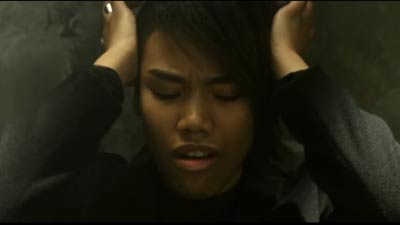
[Video]
[5.38]
Daniel Montesinos-Donaghy: Presenting… Fisher Price My First Clap’n’Stomp Falling Star Pyro Balladry: In Stores Now, RRP 170 million KRW.
[4]
Crystal Leww: This is could be a song about a boy, but if the music video is telling at all, it’s mostly a song about colorism masked as a story about a boy. Colorism is a very real issue in Asia, something I have very first-hand experience about. As a pale skinned Asian, I heard coos growing up from my many aunties and uncles about my beautiful skin, passed to me by my mother. It always made me uncomfortable because it’s bullshit. Lee Michelle is much more Asian than I, but because she is a half-black Asian, she has always been perceived as less Asian than I. As someone who grew up in America, it is important to note that the otherization of those with differences is not exceptional to Asian culture; America has its fair share of fucked up racial politics, too. But yes, this matters in a way that is real. It’s a song for the others by someone has grown up as the perpetual other, someone who understands difference from the outside looking in rather than the reverse. It helps that Lee Michelle is a hell of a singer, too.
[8]
Alfred Soto: The flaky, light R&B glaze can’t disguise the talent show anonymity.
[3]
Patrick St. Michel: The video for “Without You” and Lee’s very presence in contemporary Korean pop music are great and important developments, and one hopes that she can somehow pick up traction within the country’s music scene. Yet the song itself, taken out of context from the accompanying clip, isn’t nearly remarkable. Save for decent bleacher-shaking percussion, this is a standard ballad that’s just not that interesting on its own.
[5]
Brad Shoup: I wonder if there’s something behind the piano riff getting transposed down for the ending. Interestingly (or not, I guess — this is how pop ballads work) Lee Michelle begins the song in her lower register. Perhaps they meet in the middle. Regardless, that’s a refrain Kelly Clarkson should’ve got to first, and the thinly pumped synth line it contains feels impervious to the amplification of remixing. I bet constant radio play would make me a lot fonder. A shame.
[6]
John Seroff: Outside the context of “Without You”‘s copious backstory there’s just the esperanto vapidity of the song, under-packed and still thick with thudding, formulaic Tedder-isms subtle as Godzilla footsteps (Matt Broderick Godzilla, not Bryan Cranston Godzilla), exhausting and repetitive attempts to outshout the emotion and a piano hook that resonates for me as gently ganked from Starship’s “Nothing’s Gonna Stop Us Now.” “I’m meaningful without you” is as left-handed and soggy as self-affirmation gets and that’s as much as a non-Korean speaker is likely to get.
[3]
Iain Mew: You can approve of the message of a song at the same time as not appreciating it musically, but this isn’t exactly that. Rather, good things are in place and the song just needs some context to bring them out and be more than an unremarkable affirmation ballad. I’ll stand by my preference for an “I” point of view over “you” for those, and the clean arrangement gives Lee Michelle room to belt impressively without overpowering. The problem is the vagueness that’s almost genre standard. But take it in with the video and it all the specifics become horribly clear — the “they” the target of the song is like are the people whose racist actions she’s been dealing with forever. With that context, the vagueness takes on a more understandable light and the songs strengths become more powerful.
[7]
Edward Okulicz: “Without You”‘s glossy production is perfectly sweet and obvious to the point where it’s easy to be cynical about its bag of well-worn tricks — a light beat you can clap along to and not much more, a piano intro and outro over which to show vulnerability, little flutters of guitar and a whistling organ (I think) to tease the ear. Given this, the song needs a good vocal performance to tip it from manipulative to earnest, and I think it just about pulls it off. Lee Michelle’s voice is lovely enough that sympathy for her feels natural, even if one can only relate to the surface meaning of the song — in the sense of not understanding the Korean verses or not having lived her life. I won’t deny that by the second round of the chorus of my very first listen I was singing along and punching the air.
[7]