Not about to go away, damn it…
[Video][Website]
[6.89]
Jer Fairall: It is as exquisitely executed as it is wholly expected, the sound of an old master addressing spirituality and mortality from his own unique and privileged vantage point. The words avoid blasphemy simply by being so gracefully crafted and delivered; could any other performer render a word as densely loaded as “slave” so free of malice? In fact, it may have have all been so punishingly respectable were it not so flat-out gorgeous, Cohen’s parched Eeyore rasp supported by a gentle cast of Emmylou Harris-like backing vocals, a muted Celtic reel and a piano melody that is less elegiac than it might simply be the very notion of elegy distilled to its purest musical essence.
[8]
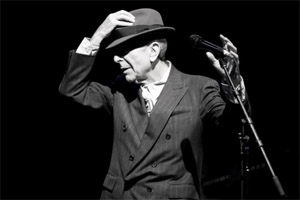
Alfred Soto: Cohen’s 2009 tour was a financial and aesthetic coup. Reimagining material in danger of being smothered by cobwebs, Cohen proved a performer of surpassing, surprising vitality. Note I didn’t write “singer.” Husking, blowing, and wheezing this would-be hymn, accompanied by old friend Jennifer Warnes, Cohen projects the granitic splendor of a statue of a Civil War general in the park, such that I can’t tell whether this falls short as a song or whether Cohen can’t coax out its melodic – not to mention conceptual – possibilities.
[7]
Sabina Tang: If other stans rate this qua stan, I’m going to regret rating it as minor Cohen. The Voice(tm) gets in the way of the hymn this time around, and one doesn’t listen to major Cohen while mentally constructing future cover versions by KD Lang, Patrick Wolf, the cast of Glee, and your high school glee club. Nevertheless, because I have the silly bone of a Leonard Cohen fanatic, I find acute comedy in the thought of a po-faced choir singing punchline couplets like “show me the place where the Word became a man / (pause for effect) show me the place where the suffering began.” Whoa, easy on the uplifting religiosity there!
[7]
Brad Shoup: In the ballad game, grizzled troubadours like Cohen, Waits and Zevon always play with house money. Cohen’s twist is to show a old man in quiet, total thrall. This is not the slavery of the Old Testament, but it’s a relationship not unlike Ruth and Naomi (which Cohen has touched on before). Led by a gospel piano progression, the song takes a decided turn into the Appalachian as the strings bleed in and contend mightily with the dreadfully trad backing vocals. The virtues of Cohen alone should be amply evident by now.
[6]
Pete Baran: When considering new material from a titan, you cannot help try to find its place in the entire body of work, as well as in the current landscape of music. So it’s great to hear that this new single, whilst cutting back on the crazy instrumentation, is still exactly what I’d expect from him in 2012.
[7]
John Seroff: My exposure to Leonard Cohen is pretty minimal beyond the best-known work, so although I know just enough to understand his placement among the pantheon, I feel I can listen to “Show Me the Place” without too great a prejudice of expectation. Honestly, it don’t sound like much. Cohen’s voice has mellowed into a less expressive Tom Waits growl, and his spoken-word dirge lacks the pathos of Glen Campbell or the indignation of Gil-Scott Heron. The much-ballyhooed poetry is — and it feels like shibboleth to even think it — not so hot. I suppose it’s possible that I’m just not getting the song, but I’d feel a lot better about copping to ignorance if I heard a whisper of anything I was missing.
[3]
Edward Okulicz: The beauty of Cohen’s work, and all its layers and interpretations is that his throat always supports whichever one sounds best to you as a listener. When he sings of being a slave in this near-spiritual, I don’t know which kind of divine bondage he’s rhapsodising about, but it’s strangely moving and graceful.
[8]
Anthony Easton: I think it was Cohen who wrote in his early 70s, about talking to his Roshi, about when sexuality flows from the body and is replaced with bodily concerns. Roshi at that point a decade or so older, said that he wasn’t sure, that it hadn’t happened yet. Even if it is my faulty memory, and not actually Cohen, I wonder if finally bodily metaphors as sexual metaphors as spiritual metaphors — the triune mystery that he has put his career on, have loosened. Here. “slave” seems to be less of a sadomasochistic desire, and more of a desire for something like the prayer of humble access, or the more abasing koans. For all of his talk of being stripped, of being torn, or being taken, Cohen in his own peculiar way has been a monster of ego. I wonder what Cohen without his mystical cock swinging would look like?
[7]
Michaela Drapes: How can you possibly turn your back upon the profound wisdom of Leonard Cohen? Even as a young-ish man at the beginning of his career, he was preternaturally wise and world-weary; now, nearly eighty, he’s the closest thing we have to collective musical conscience. So as his gritty, sandpappery voice rasps out this love/sex/death story in classic Cohen hymnal style, you know he’s heard and seen everything of which he speaks. Thank goodness he’s still allowing us to listen.
[9]