Peering down a corridor to album number three…
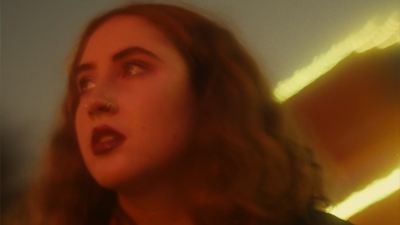
[Video]
[6.75]
[8]
Ian Mathers: No matter how (emotionally) apocalyptic Donnie Darko was, the brute fact is after a moment, a night, a week, a year like that, you wake up the next day and things just… keep going. If there are regrets, angst, etc., etc., they modulate a little into something more complicated or hard to express. In one sense you know yourself, what you want, your surroundings, your relationships, better than you did before, but frustratingly it can be at least partly in the sense of realizing the unfathomability of things. You’re no longer standing there wishing you could take back words, but nothing feels as easy or simple as it used to, even if it hurts less. “Someone tell me how I’m gonna work this out… and I thought of you.” You can see more at once in a hall of mirrors, but it doesn’t necessarily help you understand, or even give you an undistorted view. Nothing to do but hold hands and it’ll happen anyway.
[8]
Aaron Bergstrom: As far as adjectives go, “dizzying” is particularly versatile. It can easily be positive or negative. The dawn of a new relationship can be dizzying (the euphoric headrush of infatuation, the mind projecting infinite possibility into the future), but so can the dissolution of an existing relationship (the queasy vertigo of suddenly living in a world different from the one you thought you had built). Dizzying speed, dizzying choice, dizzying potential, dizzying change. Over the five-plus minutes that make up “Hall of Mirrors,” Let’s Eat Grandma seems to hit on the nuance of every slightly different usage as our protagonist struggles to find her bearings, both in her own head and in the world around her. Through it all, one phrase consistently resolves all that swirling dizziness: “I thought of you.”
[8]
Andrew Karpan: Glow-pop that gleams so hard, it causes the eyes to wince and, occasionally, squint. When the disco-flattened horn squeaked around the record with the comfort of a rubber band, I felt suddenly nostalgic for falling in love for the first time too, i.e. “the moment in time when our shadows collided,” as the pair put it here. Sonic gestures like this feel like they registered as “indie” a decade ago, but have been appropriated slowly now into the wider idea of pop, which is anything you can put on while getting out to go just about anywhere.
[7]
Mark Sinker: Sprinkled fragments in the background mainly remind me how much more I always wanted from the whole psychedelic swirlpop world than I ever really got, as if the blocks and columns and rods and chains of pretty song-shaping harmony could just be dust-devilled off into pure sweet shapeless noise. It’s nice enough I guess, but it isn’t what it could be.
[5]
Dorian Sinclair: When I was in high school, my choir director once got very irritated with me. I’d been messing around with the piano in the music room, but I didn’t really know how to use the sustain pedal appropriately. I would hold it down for bars at a time, so that chords which should have been crisp and distinct instead blurred into an undifferentiated mass, drowning out any nuance or variation that would otherwise be present in the piece of music I was playing. Hadn’t thought about that in ages, I’m sure it’s just a coincidence that I’m remembering it now.
[4]
Oliver Maier: Rosa Walton, heir to Lorde’s snarled enunciation, shares also that quality of sounding suspicious of her own hopefulness, tentatively unravelling a new feeling across a constellation of snowglobe moments. Yet she is betrayed by the music’s restraint. The throbbing, swelling beat is obviously purposeful but not compelling in and of itself, and her melodies stop short of communicating the weight of her infatuation. It’s all a tad too placid, too trapped in its own reflection. Side note: If that’s a real saxophonist and not a MIDI keyboard, then they need to not be let near a reed again.
[5]
Leah Isobel: The heavy delay on the synths feels a little forbidding at first — like auditory haze, it obscures the song’s content and competes with the vocal and percussion. It’s not until the first pre-chorus that the fog clears and the images come into focus: “I’m cold to the bone in this lonely town/Somebody tell me how I’m gonna work this out.” But that clarity turns out to be a trick. When the most real, tangible image comes in the chorus — “you linked through my fingers/and followed me into the hall of mirrors” — that heavy, foggy delay surges back, and the more it repeats the more it feels comforting and warm. On their last record, Let’s Eat Grandma figured haze as something that a loved one would cut through like a knife, an individual experience that they wanted to be rid of. On “Hall of Mirrors,” though, haze is entropic, swarming everything and warping experience into an impressionistic collage. Even the sax, which calls back to another song obsessed with contrast of haze and clarity, feels surreal and blurred; it doesn’t offer a physical ground so much as it harmonizes with the uncertainty. But its warmth shows me that that dissolution, that haze, isn’t scary. It’s what makes the moment when someone traces a line across your memory important. It’s what it means to be alive.
[9]