Except when it is.
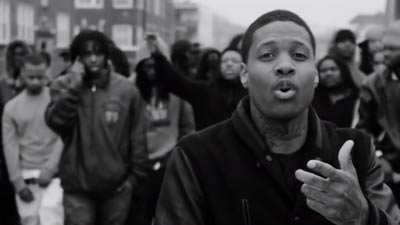
[Video][Website]
[6.75]
Andy Hutchins: If today’s other Chicago rapper is mostly cunning and strong, Durk is proud to be alive and coarse, laughing as a young man does under the terrible burden of destiny. Scolding runs through this song, as it did through his terrific, elegiac “L’s Anthem”: There’s no reason to try Durk, who puts just enough braggadocio in the staggering “I can’t do no shows, ’cause I terrify my city / They say I terrify my ci-i-ty” to keep it from being the most depressing thing anyone rapped with a mirror to self in 2013, so why would you? Why make more pain? Chicago has raised a generation of boys who became men before they had to, and Durk has sounded like a man on everything I’ve heard from him. He has no choice, I fear, and not just because he picks Paris Bueller beats with rat-a-tat snares, ominous string-ysynths, and menacing bells like this monstrosity.
[9]
Crystal Leww: Lil Durk has been compared to Chief Keef because they are currently the most prominent rappers in Chicago drill. Production-wise, that works with that lurching snare and bass combo and so many gun effects. Lyrics-wise, a much more apt comparison would be to Chance the Rapper. This is so clear and vivid in the picture it paints of Chicago’s street life. It likes to focus on what Durk knows about his place, about his experience. He’s subtly sad when he sings “I terrify my city.” To know that you, personally, are being scapegoated for something much bigger than you, personally, at age 20 is an enormous responsibility. Durk somehow manages to get that just right in the most quiet way possible.
[8]
Patrick St. Michel: An at-times self-defensive but ultimately confident song featuring the just right of aggression and twinkly reflection courtesy of Paris Beuller. Heck of a hook to boot.
[6]
Mallory O’Donnell: Which is more tedious? The sloshy rapping, the dead horse “haters” theme or the slo-mo crawl through a G-Funk dungeon? Who fucking cares.
[2]
Will Adams: Just considered the possibility that “drill” can also refer to the extent to which the hook is repeated. It’s not bad here; pleasingly tuneful, and Lil Durk adds a variation in the third verse to keep things interesting.
[6]
David Sheffieck: A complicated, conflicted rejoinder to critics of drill — or really of any rap subgenre, or of rap as a whole — masterfully executed.
[8]
Megan Harrington: Durk is often contextualized with drill and Chief Keef — it’s true that his work is often similarly dark — but he’s after something different. “Dis Ain’t What You Want” is full of sympathy. Durk advises a would-be antagonist to back off, that he doesn’t want this and then considers how he’s painted as a terrorist in his hometown for responding to that provocation. This is far from bleak sociopathy. Durk borders on anguish over his place in a broken system. His hopelessness is crushing.
[8]
Brad Shoup: Bueller’s so uninterested in flourish that his synths sound like G-funk test tones. The humming low end conjures a symphony. Durk’s never so raw as when he thinks about his city being scared of him. In that moment, he sounds so small, which makes sense on a track where he’s threatening guys one block over but still feeling the pressure of CPD. All he wants to do is sing.
[7]