If you need some context for Scott’s rock-fueled pick, perhaps direct yourself to the (subtitled!) music video…
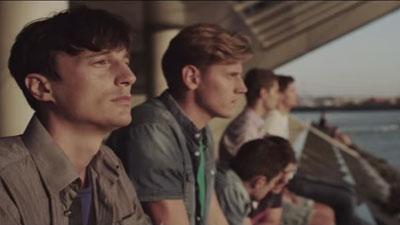
[Video][Website]
[5.29]
Brad Shoup: It’s the worst nightmare of the ESPN comment section: longer than “Hotel California,” not written by Zeppelin, and all about willing gay football players to empowerment. To be fair, this would be a slog for most people: an unceasing raspy singsong with strutting one-channel guitar and flattened brass low-end. I feel like this would have made a very good Facebook post.
[5]
Iain Mew: I sometimes wonder if subtitles to voices in a language I barely understand is the best way to receive a message. It can supply feeling and precision, but having to do the work to put the two together helps filters out much of the potential for a negative gut reaction to something sounding false or too much. I don’t know how much that adds to the combination of the strong elements of “Der Tag Wird Kommen”, but I find the song incredibly powerful. I love the way it sonically jumps straight into the fray with a kind of grim determination, with grinding bass and Marcus Wiebusch spitting words in a way that says there’s a long way to go, in the song and in society, but there’s no question of not getting there. Talking from my own privilege here, but I think the narrative approach is a good one, of making himself a secondary fictional figure, acknowledging his privilege but stopping the song from being all about him by centring the tale of a friend making the football big time. It works that he treats it as a momentous story in its own right that would ideally be bigger than the friend’s sexuality. He tells that with mounting tension that leads to a complex narrative that underpins the elements of frustration and invective elsewhere in the song. It convincingly makes the case for coming out and the case for how heavily the personal stakes of potential negative response could weigh. When it culminates in the pushing back of earlier positive words — “one will do it, but it won’t be me” — the silence afterwards is gut-wrenching. The song heads on with reassurance and a smartly chosen phrase from football culture. We’re not there yet, it says, but walk on with hope in your heart.
[8]
Patrick St. Michel: Great message that flies well beyond borders and language in 2014, but the actual music is mostly a trudge.
[5]
Micha Cavaseno: Euro-Macklemore with even more clunky rapping and generic production is a thing. People love to find abstract significance in anything sandblasted into universality to give their lives meaning in the mundane, so I’m sure the fact that this song is so self-assured that you (the audience) know how IMPORTANT their message is has a lot to do with that. And I’m happy there’s a specific message here. Yet this is the ultimate problem I have in seeking universality with rap: it coddles the listener. It implies that they need to feel sonically safe if it’s some “musical music.” It’s not really comprised of any real music, because this pop rap sound doesn’t sound like any pre-existing genre of music. This could serve as an argument that the vampiric post-modernist aspect of rap production being based in the sounds of other genres is a moot point. But it might also be that people are beginning to want nice friendly vehicles that doesn’t ward away people who can’t relate to R&B, rock, jazz, EDM, or the millions of other sounds you can rap over. And if people are honestly that cowardly about sounds, how can you trust them with words and ideas?
[2]
Kat Stevens: It’s rare to find issues-pop that’s optimistic, determined and realistic all at once. The story needs telling, but it might be 2 minutes too long for this format.
[6]
Edward Okulicz: It’s “Lose Yourself” except it’s by a German dude and it’s about gay footballers! And instead of gradually intensitifying verses, it’s more like a few distinct bits of poetry nailed together with no obvious musical structure, like a musical mini-movie (hey, I don’t watch the video when deciding if I like something). It might be my privilege talking, in that because I can get up and do “Work It” by Missy Elliott at karaoke replete with gestures in front of my boss and not risk losing mega-euros in endorsements, but only parts of Wiebusch’s delivery hit home. The section from about 90 seconds in and the piano closing are two of these. Unfortunately, the rest struggles against the unforgiving stream of consonants that makes German a language better sung than it is rapped, particularly when Wiebusch is not up to rousing me to care.
[4]
Scott Mildenhall: Thorough: a tale not just of an individual, but the evolution of a sport, society and man. It works best on that micro level though — a character study greatly enhanced by the video, bringing humanity to the media’s genuinely insatiable appetite for “the first.” Wiebusch is just as vague as them when his player says it won’t be him — who does count here? Fashanu, Hysén, Davis, Rogers? — but that stark vow of silence is saddening. Really, this can’t be best experienced without the video in mind, as on a macro level, for all it says, little is new. The comparison to terraces racism doesn’t really pass muster either, invisibility rendering it baseless, and the implicit heterosexism of “their sex is their business” does feel like the work of a once-radical, straight, 46-year-old ex-punk. It’s no act of Macklemoreing, no backward step in the guise of progress, but still somewhat retrograde, occasionally not quite “getting it”. Perhaps that’s apt — the issue remains stagnant — and perhaps the persistent trudge made of its forward motion is too; lurching, boulder-carrying, yet convinced of its title. Things needn’t always be so dramatic in reality, and haven’t been, played outside of the media hall of mirrors, but the turmoil in this instance is so meticulously drawn as to suggest otherwise. A kind of success.
[7]