Are we fiends for a big dirty ass line?
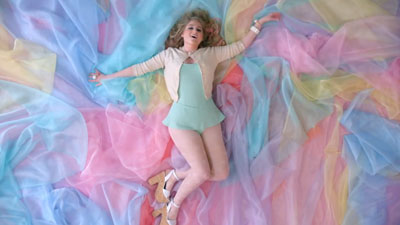
[Video][Website]
[4.14]
Jonathan Bradley: The hook is a jingle, which makes sense, since the song is a pitch.
[1]
Anthony Easton: Ass shaking as a socio-political move, as an erotic refusal of bodily control, and as a good time on Saturday night should be encouraged, regardless of how and how the texts work out. These points are mostly for the message.
[7]
Katherine St Asaph: If bass stands for ass, then what’s treble — boobs? Either Meghan Trainor is the one person in the universe standing up for flat-chested curvy women, or she didn’t think this metaphor through at all. It’s a shitty metaphor anyway — a song with no treble would be unlistenable — which makes sense, given that it was awkwardly grafted onto a title none of the songwriters knew what to do with. Trainor raps like she learned it from Luda’s verse for Justin Bieber; Kevin Kadish writes doo-wop like he learned it from Vanessa Carlton on the Counting Crows cover of “Big Yellow Taxi.” Trainor’s Miley Cyrus drawl — not the only similarity “Bass” shares with Cyrus, but I’m not going to talk about the video — is more interesting than her attempt to emulate hook-singing Fergie, but I wouldn’t want a whole album or even singles cycle of it. I can’t believe this is Top Ten; everything about it screams “minor Radio Disney hit that escaped somehow.” But unlike “Cool Kids” or “The Big Bang,” which escaped into nothing much besides a dutiful radio presence, “Bass” escaped into thinkpieceville, writers somehow finding ways they didn’t use up on Louie to chitter about yes feminist/no feminist and how fat and where fat and why fat. The websites all use the same unflattering screencap up top, a little too gleefully, and their commenters turn the bottom half of the Internet even more into burn books than usual. It’s exhausting, and it makes Trainor paradoxically ubiquitous as a cultural talking point yet a non-entity as a musician, which for an artist’s debut is deadly. In a world where “Rolling in the Deep” can become a smash with minimal cultural handwringing, why is this necessary? My guess is displaced rockism. Adele is seen as authentic enough that her music and career trajectory can be discussed on their own, but for a rising teenpop-adjacent artist like Trainor, the default assumption is that the music is nothing. Sad thing is, sometimes default assumptions are right.
[2]
Cédric Le Merrer: Obviously, when it comes to bass Meghan Trainor is all talk and no play. I really could complain that this is the kind of beat that would only ever inspire very mild shaking of the booty it’s supposed to “bring back.” But talk can have a great effect too, and like that time at the office party I had to go back on the floor I’d just left when “Can’t Hold Us” came on as I saw the only openly gay guy there having the time of his night dancing to Macklemore, I can’t completely diss a song that does what I’ve seen this one do for some friends IRL or on Tumblr. Pop’s what the public makes of it, and I rather like what it does of this one song.
[7]
Will Adams: Little good will come from someone like me — who’ll never feel the same burden of body policing as women do daily — shitting on a song that so gleefully promotes body positivity. Setting that aside, though, “All About That Bass” is among the most lackluster singles I’ve heard this year. The song is seemingly directed to multiple audiences (it’s mostly a clarion call to bigger women, but in the second verse Trainor tells a potential suitor to stay back if he’s looking for a size zero), Trainor is a limited vocalist (hear her struggle with the upper register melisma), and the trope of ersatz doo-wop was killed dead by Duffy well over five years ago.
[2]
Megan Harrington: I don’t need to explain how and why this song is dumb. If you really want to know why you shouldn’t listen to “All About That Bass,” here’s why: its closing 10 seconds are nearly identical to the opening 10 seconds of Sugar Ray’s “Fly.” A Gender and Women’s Studies class will teach you where Trainor failed rhetorically, but even if she dropped the appropriative shtick, her hit would still be deeply irritating.
[2]
Brad Shoup: Her co-writer’s resume is a who’s-who of hyuk-hyuks; pouty doo-wop with a vernacular delivery is such a weird way to start a conversation, and I wonder at whose feet I can lay the blame. Trainor’s not got the surest pipes, so maybe this was the best framing, just as a song about bigger bodies is a genius way to redirect whatever nonsense would be subliminally (or not so) popping up in any articles her team could conjure. Now she’s got a full-stop hit; she’s swimming in ink. So yeah, “All About That Bass” is all about what dudes find attractive, and — like “Anaconda” — shits on the other half of a bullshit binary. Like any hit, though, it’s doing untold wondrous things.
[4]
Alfred Soto: If you want to deliver a message in song, be sure the beats work; otherwise I’m stuck listening to Lily Allen harmonizing with herself in a Aflac commercial shown on the Food Network. I mean, nothing happens in the last minute besides repeating the hook. Imagine if Aqua had released the superior “Barbie Girl” in the click bait era — how many words and headlines would it generate?
[2]
Elisabeth Sanders: When I first heard this it was a cute self-love novelty with a couple hundred thousand views, and now my high roommate is singing it to herself in the living room and I can literally hear her as I type this, so I feel like that speaks to how pervasive (and great) this tune is. It’s a pretty simple body-positive message, but simplicity isn’t bad. I’ve heard a couple people object to the phrase “skinny bitches”; for one thing, I really don’t think that is the worst thing in the world to say, because, sorry, but not all “body-shaming” is created equal, and for another, she literally says in the next line that she doesn’t really mean it, y’allllll. Anyway, this is a well-done doo-wop song that’s also a modern pop song, and it’s nice that someone other than Ariana Grande is trying to do semi-vintage pop in a lovely sort of sassy candyfloss way.
[8]
Patrick St. Michel: Oh, I get it, it’s like a ’60s girl group song but she says “booty” and “skinny bitches.” Meghan Trainor’s pushing a perfectly great message, and it beats reading a Tumblr post, but as an actual song this doesn’t do much beyond spreading its teachable moment. The doo-wop throwback might work if The Pipettes, Lucky Soul, countless K-pop groups and probably more hadn’t already done thrilling things with the style. This uses it as pleasant wallpaper that sounds like nothing else on the charts right now and allows Trainor to get her point across just fine — which is OK, if not particularly compelling (and treated as a bit of a joke). Positive ideas getting lots of attention are swell, but that doesn’t mean the world should just settle for carbon-paper renditions of the past.
[5]
David Turner: I should’ve known this was going to be awful. I should’ve known from the title. But maybe it was going to be a dumb EDM song. M A Y B E. But nope. It’s an awful song that sounds like it was created by that group that does period accurate covers of pop songs–look it up. A 2010s pop song in the style of a 1950s pop song, isn’t that quaint. Of course not. It’s terrible and if there are any lyrics to this song my mind has yet to, and will not, consider them.
[1]
Josh Love: Works fine as a schoolyard singalong, but ironically there isn’t a whole lot of meat on this bone. A shame, because this would have been really terrific if it sounded like Big Freedia rather than a cutesy trifle. Perhaps, sadly, Trainor felt that in order to put across her body-positive message she needed to house it in a Trojan horse of sexless novelty pop, but her slangy slurring in the verses (“got that boom boom that all the boys chasin'”) suggests the song’s title might not be a total musical lie.
[5]
Jer Fairall: A more convincing body-positivity anthem than Nicki’s inexplicably overpraised “Anaconda” precisely because it is a more generous one: Trainor uses the Spectorian swing of 60s girl group pop as a means of encouragement, complete with advice from Mama passed on to her audience, while Nicki’s misuse of “Baby Got Back” negates any of the source’s goodwill by focusing “Anaconda” solely on herself. More good-in-comparison than actually good, the contrast between the two tracks (one the latest step in the pre-release campaign for a Blockbuster Album Event, the other already relegated to the status of YouTube novelty) is nevertheless instructive.
[6]
Madeleine Lee: The lyrics are Dove commercial feminism as written by someone in the “DOVE AND AXE ARE OWNED BY THE SAME COMPANY” phase, and it already sounds like its own acoustic YouTube cover. But it’s catchy and not too self-important to be fun — Trainor knows it’s really all about that hook — and I’m not averse to the idea of little girls dancing to this with their moms in the kitchen.
[6]