WE ARE MAKING OUT IN AMNESTY WEEK OUT OUT OUT. Iain kicks things off with some gritty electro…
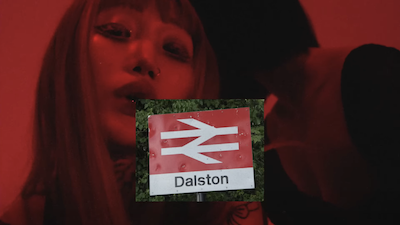
Iain Mew: Yeule has long had a thing for exploring and collapsing dichotomies. They started off 2022’s Glitch Princess with a whole spoken track of doing that; the most triumphant moment on 2023’s amazing Softscars was a song called “Cyber Meat” with angels and demons and “there’s a boy and girl inside me too.” The key moment on “We Are Making Out” is when its headlong makeout journey gets to “we are making out online/we are making out in real life”: making out as something immediate and physical, but also making out as a state of mind. The litany of London transport routes is transformed into an attempt to become one with the entire city, in the hope that it might intensify the feeling. Mura Masa matches all that by taking a hedonistic “I Love It” grind and colliding it with something much sweeter, in a way that adds something to both.
[9]
Dave Moore: It feels like Mura Masa has been in the EDM wilderness since he ditched the bells, still able to launch an obnoxious electrobanger, often in collaboration, but without a sense of a trademark sound. This collaboration with Yeule doesn’t revive a personality, but it does focus him. The insistent straight-ahead dirty techno synths sound more organic than usual while Yeule sounds less, a good look for both. Dogged pursuit of the dance, gritted teeth all around, but it works for two minutes before an abrupt acoustic coda so everyone can take a bio break.
[7]
Julian Axelrod: This is not a song about making out. There is making out, but the making out is secondary. This is a song about transit lines and transfers. It’s about the hours of dusk, dawn, and various hours in between dusk and dawn. It’s about the blurry digital and the bruised physical, and if it is about making out, it’s about the moment where you’ve mashed your faces so far into each other that it’s not romantic or sexual anymore, just about creating one giant face. More than anything, it’s about that queasy, electrifying synth churn at the center, which sounds exactly like how your computer screen looks at 4 a.m. But please, don’t try making out to this at home.
[8]
Frank Kogan: Smudgy vocals are making do, if not making out as claimed.
[6]
Nortey Dowuona: The dopey guitar chords near the back gesture to the giddy romanticism that Yeule outlines, but otherwise the fuzzy bass synthesizers clog up the mix and fight with their voice, itself clotted with fuzz effects. The entire mix blurs into a buzzing rasp during the verses then a rubbery shudder during the refrains, except for brief moments of relief: a hard hit at the end of each measure to give structure, a hi-hat riff in the middle, the chorus replayed softly over a diminished bass line that slowly fills the mix.
[5]
Alfred Soto: The synth buzz is a threat, an overture, a command. Resist and get rolled.
[7]
Jel Bugle: It’s a nice, simple song — I liked the little coda at the end. Not familiar with Mura Masa, but I like Yeule, and Yeule is usually more exciting than this. All this mention of London train lines was also very distracting, as I was led to think “do those lines meet up? Where are they travelling to, and from where?”
[6]
Tim de Reuse: Public displays of affection and rough, noisy synthwork and rapid metropolitan transit systems: three of my favorite things. The road-trip pathos of the repeated I-IV wears thin by the middle, though; after running out of places/mindstates in which to make out, we flounder around, chopping and screwing out of obligation. Despite the confessions of love, none of the back half has the same intimate specificity as the way Yeule enunciates “…on the BakerLOO line.”
[6]
Jacob Sujin Kuppermann: Finally someone understands the unspeakable eroticism of public transit!
[8]
Kat Stevens: That’s one way to avoid dealing with the accordion busker menace.
[6]
Ian Mathers: I really enjoy how this splits the difference between reportage and command/prediction, dispassion and fever, rough and sleek. Even the little acoustic guitar coda stays on just the right side of whiplash.
[8]
Katherine St. Asaph: Electropash! This doesn’t quite capture the feeling of making out — the birds-eye narration suggests mediocre first-person fiction trying to convey a sense of immediacy, rather than the real horny thing — but does perfectly capture the feeling of a Dragonette mp3 segueing perfectly into Icona Pop on the train while you’re catastrophically trashed. The outro is the part of that feeling when you realize you miscalculated your buzz and fade out before the night’s done.
[7]
Aaron Bergstrom: Relatable: Alternate universe Charli XCX doesn’t actually know how to get into any of the cool parties and at some point just wants to go home.
[7]
Brad Shoup: A knuckled monosynth goosing a list song about all the places and reasons we snogged? Blog house is back as hell. There’s an electronic cymbal that hits like a whipcrack, and an Six Parts Seven-style outro that might function as a bonus late-’00s sendup: this time, it’s the rootsy sincerity that condemned indie rock to death.
[7]
Taylor Alatorre: The twee acoustic outro is a blissful admission of defeat — their late Millennial sentimentalism has prevented the artists from making the ode to no-strings-attached handsiness that they initially set out to. They follow the bratty zeitgeist and aim for Miss Kittin but end up landing closer to Dragonette, which is more taboo and therefore more fitting. The “online / real life” dualism might seem overly pat if it weren’t coming from the person who did the Lost Memories Dot NetOST — Yeule knows of what they speak. They dream of a hook-up that leads to something more, then soak in the dream for as long as possible for fear of what comes after. Makes sense that the waking confession could only be an accidental one.
[7]
Wayne Weizhen Zhang: Now accepting applications for friends to listen to this absolute banger with. No reason in particular ¯_(ツ)_/¯
[8]
Will Adams: Making. Out. With. Mura. Masa. And/Or. Yeule. Is. Totally. Awesome!
[7]