You’ve got the mask, but have you got the touch?
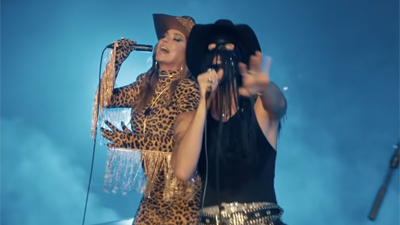
[Video]
[5.11]
Katie Gill: Look, I saw Shania Twain in concert in the year of our lord 2018 and regularly listen to the 1990s country station on Pandora — this is my trash. This is Peck writing his best late-1990s/early-2000s country song, and hey, why not get the queen of late-1990s/early 2000s country herself to join in for a duet? There’s not much new here, there aren’t any boundaries being pushed. This is reveling in nostalgia, pure and simple. But it’s a nostalgia that I’m fond of, and it’s nostalgia done well. It homages, not parodies, and homages in a perfect way.
[7]
Tim de Reuse: As soon as the acoustic guitar came in, shimmering with four-chord gusto, I was worried. Orville Peck’s debut worked because the sparse, loping instrumentals left plenty of space for the campy weight of his voice; here he is completely boxed in by all the obligatory sonic fluff demanded by modern country music. When he’s singing alone he sounds out of place; when he’s harmonizing with his co-star, their voices sound like they’re trying to sumo-wrestle each other out of the spotlight.
[3]
Thomas Inskeep: I want to like Peck, but he always sounds like he’s posing at country. His Rufus Wainwright-isms and his crooner thing (is it a schtick? I’m never sure) completely take me out of genre, and suddenly he comes off as more baroque-pop than country. I still don’t like the way Peck sounds on “Legends Never Die,” but it sounds like a country song, in its songwriting, its production, its arrangement. And then there’s Twain, who hasn’t cut anything this twangy since her ’90s glory days, and sounds superb. (Her voice, of course, is impeccable.) This is a strong like-don’t-love for me, but frankly I’m just happy to finally like an Orville Peck record.
[6]
Alfred Soto: Did you know Orville Peck covered “Smalltown Boy” this year? A touch portentously, but I respect the countrified version. It puts his talent in a better light than this plate of cold scrambled eggs. Imagine if Shania Twain dueted on “Smalltown Boy” — think of how she would’ve sung those keening harmonies.
[4]
Steacy Easton: Shania is one of the most transparent artists on record. She knows exactly what she is saying and is explicit about broadcasting it. Peck thinks he is forever too cool for the room, pretending to be a country star, but isolating into this above-it-all shoegazey ironic wink. The combination makes Twain kind of float through a track that ignores her at best and has contempt for her at worst.
[1]
Katherine St Asaph: Every time I notice the deterioration of Shania’s voice I feel like an asshole, but it remains… noticeable, and presents here as a vocal that’s alternatively heavingly labored and indifferently smeared with autotune. Meanwhile, Orville doesn’t sound country so much as Meat Loaf, in his quaver and self-conscious Acting. Neither vocalist sounds natural or comfortable — not alone, and definitely not together, as they bump into each other’s cues. They render the subtle, poignant, and admittedly gorgeous arrangement not rootsy but rootless, an audio green screen.
[4]
Jacob Sujin Kuppermann: The intersection between Peck’s campy, country-goth indie and Twain’s campy pop-country is essentially Lady Gaga’s early stabs at roots–iness— winking in its use of twang and overdrive, but sincere in its message and connections to country history. Peck and Twain’s melody soars like the Marshall Tucker Band, and the guitar strums sound like Neil Young’s golden age. It’s the kind of revivalist schtick that’s easy to write-off as overly contrived, but in its contrivance, “Legends Never Die” feels all the more heartfelt.
[7]
Tobi Tella: There’s a thoughtfulness to this that really puts it over the edge; I could easily imagine a drippingly literal version of this song with no tact. The engagement with the sentiment of the song, with the self-confidence and pride necessary to propel oneself to icon status, is pretty potent, but its casual and winking nature stops it from ever becoming self-serious. “Legends Never Die” would sound fantastic on country radio, but it doesn’t need to be played; the song’s sheer existence is already a massive victory.
[8]
Juana Giaimo: The beginning of “Legends Never Die” is captivating; there is suspense in the beatless verses, and the loneliness and defiant tone of their voices come through. But once the chorus kicks in, that magic is suddenly lost, and it starts sounding like a fun song — which is all right, but it seemed like it would be much more.
[6]