A minimalist maximalist or a maximalist minimalist?
[Video][Website]
[6.71]
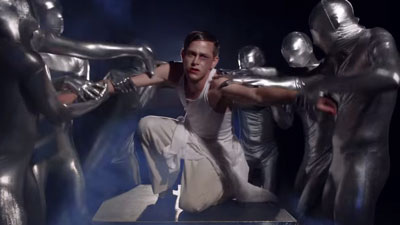
Brad Shoup: The whole track’s like a jump blues tone poem: what Scott Walker might have coughed up in one of his more lucid moments. The last 40 seconds in particular sound like Hell’s bar combo, nihilistic and more disquieting than those screams, which are almost pitched like real notes.
[8]
Micha Cavaseno: You know how, technically speaking, Suicide was always supposed to sound like some frightening industrial hell version of Dion? Yeah, this is that. I don’t know if the song here is as powerful in emotion as some of those songs, but the same way a lot of those early doo-woop songs were drenched in a downright spooky sensation, this has a VIBE. And the vibe has me sold.
[7]
Alfred Soto: Mike Hadreas’ minimalist miserabilism is so outside my purview that it requires patience and an imaginative leap to endure. Like Robert Lowell he sets his prayers at a level of abstraction that makes his work inscrutable if not incomprehensible to my ears. Here, he almost gets a setting worth the effort. Punctuated by cries and peals and the steady pat-pat-pat of a drum, he opens up. A bit.
[5]
Abby Waysdorf: It is basically a Suicide song without any updating, or even much variation on that formula, but I really like Suicide.
[8]
Anthony Easton: There has been a clutch of mostly formal, queer male melancholics, writing songs that work somewhere between macro politics and micro feelings, of late–and it’s fair to lump Perfume Genius among the John Grants, Owen Pallets, Patrick Wolves, and the like–the assumption of listening to Tori at 17, and having that infused into a sexualised suffering, constantly re-asserts itself. As a meloncholic queer person, who spent a lot of time working through Tori, and who writes somewhere between the deeply personal and political, the exhaustion that is found in these works is my exhaustion, I can claim it. But, you know, I don’t want to claim Perfume Genius. I don’t know why though–I find his work precious, and less brave, almost silly at times–intended to be at the end of a trend piece in the Sunday Times, and so the writing is full of hooks, the music is gorgeous, but it seems to be at the fag end of what could be considered a failed experiment. I never would have considered the expriment failed before this.
[6]
David Sheffieck: Maybe it’s just the ebola – it’s almost certainly the ebola – but this strikes me as pop for the postapocalypse: relentless, catchy, and filled with nightmarish hooks. Bring on the end of the world.
[8]
Jonathan Bogart: This would be a great way to break up a couple of more ponderous tracks on an album.
[5]