but fair…
[Video]
[5.27]
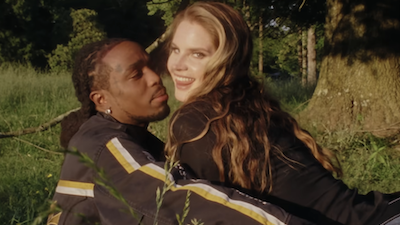
Julian Axelrod: Lana hopping on a Quavo song seems random until you look through her posts from Hangout Fest in May and realize this is exactly the kind of song you’d make after spending a weekend in Alabama partying with Jelly Roll and Sexyy Red. Even more impressively, Quavo meets her on her home turf and acquits himself nicely, from the slurred-sung verses to the swampy hook to the bit on the outro where they recreate the end of the “Telephone” video. I tend to bristle when non-country artists try on the genre signifiers and half-ass the music, but everyone involved keeps a straight face without feeling too stiff. Quavo’s coming off a tough year, and if he wants to make his Did you know there’s a bando under ocean blvd, I’ll welcome it with open arms.
[7]
Leah Isobel: I mean, it’s nice to hear Lana do a song that’s attempting some kind of pop resonance. She’s so deep into her own mythology that hearing her try to reconnect with the mainstream is interesting. But while “Tough” achieves an easygoing appeal from its guitar twangs and loping rhythm, it only ever feels like an aesthetic exercise, an experiment in negative space: its attempts to accommodate both Lana and Quavo result in a flattened song that complements neither.
[5]
Alfred Soto: The moment for this duet has passed — imagine it on Lana Del Rey’s Lust For Life seven years ago in conversation with the other collaborations. As an abstraction — a distraction — “Tough” is not much at all.
[3]
Will Adams: Quavo and Lana sound good together, but so did she and A$AP Rocky and Playboi Carti on their respective Lust For Life collabs, both of which were more interesting than this bland soup of country signifiers. At times it really feels like the hook is going to go, “Tough like the new Ford F-150. Lease now with 0% APR.”
[5]
Harlan Talib Ockey: The chorus sounds just like the Weeknd’s “Starboy”, which I realized halfway through writing this review and now find incredibly distracting. That aside: Lana Del Rey’s previous collaborations with rappers have sounded like they’re work friends, rather than real friends. (It’s still unclear whether she and A$AP Rocky were even talking about the same thing in “Summer Bummer”.) In “Tough”, however, her chemistry with Quavo is not only existent, but genuinely moving. Quavo’s delivery alternates between soft and anguished, coming off as particularly vulnerable — Del Rey’s sighed initial consonants do the same. Using thickly reverbed guitars to create a pensive, dreamlike feeling is a trick that doesn’t go out of style. “Tough”, for all its nostalgia, never sounds retrograde.
[8]
Nortey Dowuona: Jaxson Free, co-writer of previous Kane Brown’s “I Can Feel It,” is credited alongside prodigy Maddox Batson, singer/songwriter of “Tears in the River,” and Elysse Yulo, whose only other credit is Dan Harrison’s “Running Out of Radio.” Their contributions are those of many a songwriter in the music industry: patiently and with great humor assembling a patchwork of lines, melodies, and counter melodies into a track left with each of their publishing companies, praying to the empty sky that their hard work will yield them a windfall. This song of theirs is not very compelling despite the effort poured into it by all parties involved (except Cirkut, who probably put in the terrible trap drum pattern), but it has become successful, and thus Jaxson, Maddox and Elysse live to write another day.
[4]
Taylor Alatorre: The producers, led by Andrew Watt at his most sangfroid, go to great lengths to pre-empt any hint of discord or chaos to convince us that what we’re hearing is natural and normal and, most of all, inevitable. This is Quavo and Lana doing a wistful country-trap duet about a Southern-fried romance, and this is what was always going to sound like, and you’re a sucker if you expected or hoped for anything different. The repetitive insistence of the sixteenth-note click track seems to taunt me with its imperious sense of destiny — the aural manifestation of There Is No Alternative. “If you come from where you come, then you were born tough.” Yeah I guess.
[4]
Katherine St. Asaph: I’ve written the same blurb on every Lana Del Rey single for years because we have a core, unchangeable musical incompatibility: I do not enjoy soporific music, which is what Lana Del Rey primarily makes. “Tough” seems custom-engineered to prove my point: the first YouTube closed caption is [TWANGY GUITAR MUSIC STARTS], and I was fully prepared to just make that my blurb because nothing else was sparking any interest. Then Quavo’s part comes in, and maybe I’m just confusing quality with loudness or the presence of a beat (it’s happened), but it’s astounding how much dynamic the song becomes in that instant. (Someone else can unpack the morass of politics.)
[5]
Jessica Doyle: There is a risk, in talking about the silver linings of a particular cloud, of being seen as endorsing the cloud. (Elif Batuman just talked about this, in relation to David Copperfield: the horrible treatment David receives in school persisted in part because his classmates, looking back, waxed nostalgic.) The signifers in “Tough” all point back to clouds: the specific horrible tragedy of Takeoff’s murder, but also more general adverse childhood experiences (the “stuff in your grandpa’s glass” line becomes more ominous the more you think about it). Reformers push back on the idea that treating people badly to make them “tough” has net benefits, and rightly so. But it’s difficult to do this without suggesting that your listener is erring in finding the silver lining of their own adverse experiences: your rejection of their retelling of their own story. There’s a political dimension here, too — or, rather, multiple political dimensions, in that the likelihood of having lived through adverse childhood experiences is in itself a class divide. (See Charles Murray’s now-outdated bubble quiz, or basically anything Rob Henderson has written.) The adult who suffered less as a child may be better equipped to estimate the damage done, but also may be driven to smug, condescending judgment; the adult who suffered more may be justly proud of what they’ve accomplished anyway, but may also be driven to defensive bleating nastiness. I don’t know if “Tough” was conceived or written to thread this needle, with Lana, presumably on one side of the divide, offering affirmation and a sympathetic ear, and Quavo, on the other, trusting her with his story. (Sentimentalist that I am, I want to believe that someday they’ll go on a road trip and she’ll introduce him to her friends at the Florence Waffle House.) I’m inclined to call “Tough” not great but very good, a skilled piece of American mythmaking. Which may be exactly why others might hate it. And they might be right. But we may never have the world where it’s not necessary, no matter how much we improve, and given that, we’d be worse off without it.
[7]
Jonathan Bradley: Quavo and Lana Del Rey are each practiced at creating rich dramas from the artefacts and artifices of their respective worlds, but in “Tough” they struggle to find a way to mesh their outsized personalities into a coherent whole. Del Rey likes to play as a damaged all-American princess or fallen starlet who can be as plucky as she is fragile, but she doesn’t seem to know which side of herself to put forward here. Somehow she barely leaves a mark on a line pitched perfectly for her like “I’m cut like a diamond in the rough”; the only time she only does more than waft is when she giggles in the outro in response to Quavo’s charming invitation to play Atlanta tour guide. The woozy, gothic arrangement is Del Rey’s territory, and Quavo finds some smart ways to adapt himself to it, accentuating the melancholy in the icy allusion to his band’s recent past on “if you ever lost someone that you love,” but he more often sounds like he’s restraining himself from overshadowing his duet partner. The pair finds fleeting connection at “tough like the stuff in your grandpa’s glass”: for a moment, all the details sound real, the imagery interlocking in the burn of an old man’s rotgut whiskey.
[5]
Ian Mathers: Two middling tastes that taste… fine together.
[5]