Turn that cherry out!
[Video][Website]
[7.29]
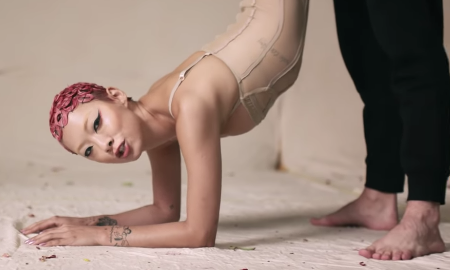
Jessica Doyle: The thing I admire about Sawayama’s work so far is how her song structure is recognizably pop, not experimental, and yet within that structure she puts together narratives that are at once specific (“Now it’s Tuesday”; see also the magnificent “biting the shit out of her straw“) and flexible enough to be recognizable. (I mean, yes, the story here is clearly about sexual attraction, and yet it’s easy to tell a story in which the narrator never actually gets together with the girl on the subway; the joy, power, and fear come from the awakening of the desire but isn’t dependent on its fulfillment.) Her sound is fresh and challenging without requiring the listener to forfeit all need for a hook. It’s impressive, the way she embraces constraints. One extra point because both the official video and the behind-the-scenes video, in the notes, list all the dancers by name.
[9]
Nortey Dowuona: Rina slices through the humongous, cuttlass sharp bass, thudding, heavy lidded drums and glassy, watery synths to peel out a stunning hook of pop.
[10]
Micha Cavaseno: A hypothetical scenario game for the reader: Let’s say from the ages of say 8 to 14, the most dominant music in your life was hair metal. Hell, maybe this is the case for some of you, so let’s proceed! Hair metal punctuates your adolescence and then eventually you get bored of it as you mature and more music occurs and decide you want to try to diversify your taste. As time goes on however, you mature as a person, becoming aware of your responsibilities and obligations to the world, while also seeking to challenge everything around you: it calls to you. Hair metal. You constantly go back to hair metal because the merits are now very easy for you to crystallize and you can see who tried their hardest to avoid the easy pitfalls that made it embarrassing or even regretful. Then suddenly, people start making hair metal again, but with a twist! The hair metal reflects the modern age, nostalgia, the shifting sense of the world and sentiments. Suddenly, hair metal is speaking to you on your terms. And, not to mention, it manages to be some really kick-ass hair metal that perfectly gets what worked so effectively back when you were young. It works so effectively you ignore the fact that rock has moved on a good two or three times minimum from the days of hair metal… Now, replace hair metal with the pop of the late 90s and early 00s and that’s what you get with “Cherry” and a lot of Rina Sawayama in general for me. That isn’t to say she can’t make high quality pop of the kind I loved back in the days before my teenage years hit and I started getting pretensions about being Into Music. The production’s slickness is a gentle familiarity, and she addresses the nostalgia with a casual admission and none of the “REMEMBER THE 90S!?!?” nag; she also touches the most noble of bases while returning to a pop that doesn’t admit what about it you realize was inadequate or even of questionable intent. Enjoying “Cherry” comes with a disconcerting admission that rather than admit we can’t make the world adhere to our expectations, we’d rather construct an idealization of our past which is much more suitable.
[6]
Ian Mathers: It’d be lovely to just appreciate the effervescent “Cherry” on a purely pop level (right down to those airy, post-Carey backing vocals on the chorus), because it’d be lovely to live in a world where writing and singing about non-heterosexual romantic feelings and relationships was just, as it were, another colour in the rainbow. But this world is manifestly not that world, which leads to the pit in the middle of “Cherry,” a song expressly about, among other things, feeling guilty for identifying as (for example) pansexual when one is currently in a straight-passing relationship. That doesn’t make “Cherry” a worse song — if anything, I’d argue it makes it a better one — but it does mean you’re going to get a little melancholy to go with all that joy.
[8]
John Seroff: I dig Rina’s voice, the song’s general vibe, and the song’s message of inclusivity but the total package is too slick, emotionless, and flat for this to leave a mark.
[5]
Joshua Minsoo Kim: Rina Sawayama’s “Cherry” details an experience that the singer had as a teenager, one that led her down a path towards understanding her sexual identity. She relays the conflicted feelings she had (“I live my life within a lie”) and the importance of wrestling with them (“Holding onto feelings I’m not used to feeling, ’cause oh they make me feel alive”). “Now I wanna love myself,” sings Sawayama in the bridge, proud to finally know who she really was all along. It’s heartening and encouraging and bold to hear such a song, especially one from an Asian, and its importance has been proven: some fans have been inspired by the song and Sawayama’s own coming out to do so themselves. Knowing all this, it’s kind of a shame that “Cherry” doesn’t have the strongest hook. Like most of Sawayama’s works, it has an interesting and engaging idea that gets its message across in a relatively procedural manner. The result is a song that feels like it should be catchy but feels more inert. But in this particular case, maybe the dissonance and the semblance of mental processing are appropriate.
[5]
Vikram Joseph: Rina Sawayama’s had quite a 2018 — she started the year playing tiny venues and ended it with a headline show at Heaven, a cult following and an engaging, talismanic social media presence. Even more hearteningly, she’s felt comfortable embracing her truest self; “Cherry” is a self-styled “pansexual bop,” and it’s every bit as queer and effervescent as that implies. It’s cut from the same cloth as “Ordinary Superstar” — a playful, sweeping, streamlined pop song — but if you’ve heard the RINA EP you won’t doubt her range. Still, this feels like a huge personal step forward from the EP; the insecurity and anxiety that filled every crevice of a song like “Tunnel Vision” is still present in trace elements, but “Cherry” makes coming out sound wild and fun — a world of possibilities and opportunities fanning out in spectacular colour, uncharted lands just waiting for discovery. There’s joy in this mess, too.
[8]