Elastic voice.
[Video][Website]
[6.29]
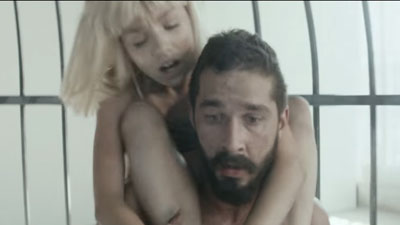
Luisa Lopez: One of those rare songs that grows in beauty as it goes on, allowing itself at first to be somewhat hollow, peaking in moments of odd aggression, staggering through the weirdness of crescendos belonging to other songs before it becomes a beast of its own, kneading bathos and sincerity together. Which goes for that video, too: I know we’re supposed to live like we’ve never read Lolita, but has that been possible since 1955? Intentional or not, a man covered in dirt will always look like a monster next to a little girl even if it’s just because he’s tall. When my roommate and I watched this together, the ending made her laugh and she said, “It just goes on so long.” She was right.
[6]
Mo Kim: Sia is an emotive singer whose approach sometimes works and sometimes steps into melismacrobatics. The instrumentation here is at least partially to blame. “Chandelier,” for instance, worked because it had bombast to match its singer. Here, Sia drowns her sparse backing, the last chorus descending into an echo chamber of caterwauling. Another choice troubles me: the original version of this song had The Weeknd taking on the second verse, balancing the anguish between two singers and letting us see the hurt from both sides. This version has Sia tackling it all alone, and I can’t help but feel that it suffers for the decision. Her last album was a beautiful exercise in isolation, taking us into some of her darkest stories and confessions with nary a guest star to be found: even there, though, there was this one duet about aftermaths and recoveries left as a landmark halfway through the album, another person let into an empty room. Even the best of us can’t always hack it on our own.
[5]
David Sheffieck: The best thing Sia did in 2014 was reclaiming The Worstnd from “Elastic Heart.” Even more than “Chandelier,” this is the quintessential Sia song: an encapsulation of her persona and thematic concerns in four minutes of sweeping emotion and glorious musical climax, at once breathtaking and wrenching.
[10]
Brad Shoup: Her vocals are just as stretchy, of course: winding down and speeding against the meter in order to achieve maximum emotional impact. On her record, it’s another sold-out one-person run. On the Hunger Games soundtrack, she masses enough takes to outflank The Weeknd, whose brief, nude showcase is a shivering slab of need: absolutely perfect support. And yet when Sia returns to rub against that seven-note, chopped vocal sample, it’s as if he was never there.
[9]
Alfred Soto: No shilly-shallying — it goes right to the swirling chorus. I wish it were a good chorus.
[3]
Will Adams: Sia’s pop writing is still distended; maybe it’s just the tempo, but it always feels like she takes forever to get past her choruses. Diplo’s thwacking percussion adds some interest — necessary because these inspiring anthems keep landing with decreasing impact.
[5]
Micha Cavaseno: Taking a voice known for its owner’s laser-like voyeurism and spinning it into a prismatic dazzle, Sia croons over the fragments to delve inside herself and comes out with fairly standard fare. Its always strange to remember she is the singer from “Little Man” and “Waiting Line” considering how her jazz/soul inflections are now replaced by something else which is seemingly so… her. The “Sia Thing” has been discussed on songs she’s penned for others and herself aplenty. What makes me more curious is how that since her vocal change-up, she’s found this style as her home, for better or worse. What made her find such a home here, and what makes this so compelling for people?
[6]