Today we’re looking at songs from some recent big albums, starting with the biggest of all…
[Video]
[5.18]
[8]
Andrew Karpan: If perhaps she’s increasingly unbearable/indiscernible as an album or era length concept anymore, I nevertheless dig to these disco-style late-whatever singles from T. Swift industries; the best ones all sound like something from the extended Lovers era, i.e. Midnights-condit., which is to say, echo the bold energy of 1989, but heard from afar, distantly, as if over an ocean. “Opalite” is probably the best of them, since, I dunno, “Bejeweled,” and it works because it is a love song about the rush of a rebound as a kind of romantic and existential zen; aren’t things great now? It’s a good question to ask and I like the way it also sounds like something David Bowie would cronk out in his “Loving the Alien”-era too. There could be worse dispatches of decline.
[6]
Katherine St. Asaph: Finally I understand what everyone means about Jack Antonoff turning every song he produces into wan synthpop. (checks credits) Wait, this isn’t him?
[4]
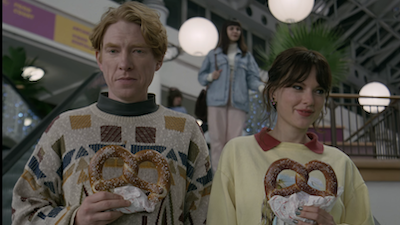
Al Varela: Part of me is a bit disappointed that this is the best Taylor can do for The Life of a Showgirl. I’ve stood up for her past couple albums of indulgent, wordy melodrama and in return I get a pop album full of colorless fluff and overwritten headaches. It’s a fun, groovy bop that will hit me in a good mood, but I also could have gotten this from most other pop stars in the industry today. Something I can’t say about singles like “Anti-Hero”, “Cardigan”, or even “Fortnite”. Say what you will about the most embarrassing moments of the past two albums, at least no one else could have written them. I still enjoy “Opalite” a lot because I like bouncy pop hooks and this is the tightest production Max Martin and Shellback gave her this album. Probably the song off this album I go back to the most (video is a lot of fun too). But I dunno, maybe an artist with such immense talent and control over her own music should be trying a little harder.
[7]
Taylor Alatorre: In the hopes of avoiding defamation lawsuits, Wikipedia has a policy called BLP, or “Biographies of Living Persons,” which states that any material added about a living person must be written “conservatively and with regard for the subject’s privacy.” Something like this policy might explain why a Taylor Swift song about her current lover tends to sound more cautious and committee-approved than those written about her exes. Whether this is done out of love or loss aversion, it’s an understandable tendecy, but it does have a certain distancing effect on the listener. This divide can be heard within “Opalite” itself, where Swift sounds more alive when she’s dryly dousing Travis Kelce’s old flame (“She was in her phone” – how Jonathan Haidt of her) than when she’s gassing up her present-day partnership. There’s also a distance created by the title itself, which shrinks the enormity and immediacy of an allusive night sky down to a grubby little gem, all so there can be another corner of the English language (“cardigan,” “era”) that is forever Swift. In the end, though I am not immune to the charms of a “Be My Baby” reference, especially when it arises organically out of the song’s unfolding structures, as if there were nowhere else the song could possibly end up.
[6]
Claire Davidson: It’s hard to find much to say about “Opalite,” if only because its strengths and weaknesses so closely resemble “The Fate of Ophelia.” The most pressing flaw hindering “Opalite” is its severe tonal whiplash, pairing a morose set of verses with an intensely chipper hook — only this time, rather than leaning into the melodrama of Taylor Swift having found true love, “Opalite” sees Swift chanting her message of reassurance like a cheerleading routine. It’s an approach that sounds all the more like it’s being sung through gritted teeth when contrasted with the downbeat sentiment that precedes it. Given this sharp polarity of emotion, Max Martin and Shellback have a hard time striking any kind of atmospheric balance: the verses are draped with a gauzy acoustic guitar refrain that feels ripped from Post Malone’s “Circles,” and the bassline is placed jarringly high in the mix, ostensibly to make for a smoother transition between Swift’s brooding and the song’s eventual lovestruck gallop. The most I can say for “Opalite” is that it paints a more convincing picture of Swift’s struggles navigating heartbreak in the public eye than much of what appears on Showgirl (or, indeed, The Tortured Poets Department). Its central metaphors of living with ghosts and eating out of the trash aren’t particularly sophisticated, but when delivered in Swift’s more plaintive lower range, they at least feel more true to her sense of tunnel vision than the overworked word salad of some of her previous releases. That Swift felt the need to transform this dejection into an aspirational bop says more about her own coping strategies than I feel is appropriate for speculation here.
[5]
Leah Isobel: Perfectly fine playlist-filling pablum from my second-least favorite working artist. The edgy ambivalence of the verses is quite nice, but in typical Taylor fashion, the chorus has to burst into smiley sunshine happiness time. The enforced cheer grates on my nerves.
[4]
Jacob Sujin Kuppermann: Relative to the other songs on The Life of A Showgirl, “Opalite” does no harm. This doesn’t mean it’s good, of course. At this stage of her career, Taylor Swift can write breezy hook machines like this one as a matter of reflex, but something about “Opalite” feels even more perfunctory than usual. It’s a shrug of a song, a good-times-are-here bop that doesn’t leave much of an impression at all aside from the “Be My Baby”-“Uptown Girl” riffing and the bit about eating from the garbage. If you’re the biggest pop star in the world, shouldn’t you want to be more interesting?
[4]
Alfred Soto: It’s got a hook, a blessing with Swift’s post-Folklore material. Whether it deserves singing in public is another matter. Her cadences lazy instead of leisurely, her lyrics devolving into exercises in cynicism clothed as shows of wit, she doesn’t so much risk caricature as attain an imperial detachment from her own work.
[4]
Nortey Dowuona: The delusions of grandeur that infect children who find art as the poultice upon their wounds are mystifyingly tight upon the mind. No matter how unassuming, humble or self assured you are when you first approach the pieces you wish to pour over, then pour bleach onto to scrub clean, then dry to paint upon, the delusions seize you once they become bigger, angrier and more insecure. As your time ends, they puppeteer your crumbling body into the violence and cruelty that come from refusing to accept one’s relative powerlessness. So after a while. you must cast them off, cash in, and relax. The art has healed your wounds, reassembled your self perception, sealed away your fears for the time being. Best to retreat and hide away in the comfort your art has brought you. But that isn’t enough for any of us. Art is not a supernatural creation. It is a personal assembly like carpentry or coding, one that provides so many with an identity and sense of self, and one that those who do not have or want one will seek to destroy with our own personal assembly. Envy and jealousy can obscure the desire and desperation beneath, but they will thaw and melt away, slaving you to them forever and leaving you unrealized and destroyed. Many of us will decay in an instant and regard the ones who have found a perch with a envy that consumes us. And they will watch us paddle back and forth, full of resentment and envy themselves as to how one does not need to create code for prompting nor a table for a coder to type upon, wondering how they cannot be that free. Both delusions. There is no freedom from this delusion, only death. Maybe a cup of tea or a cup of drinkable water will do.
[6]
Ian Mathers: It’s rare that a music video changes a song’s score downwards, but here we are. Oh-oh-oh!
[3]