Wherein we cross Matos’ palm with silver…
[Video][Website]
[5.78]
Michaelangelo Matos: Hahahahaha, I can read the other blurbs already! (Cibula, Lex, Skidmore: my sympathies.) Me, I have some patience for pretentious shit like this: I enjoyed the time I saw Marilyn Monk, for starters. Eleven-minute suites I have as much conceptual time for as, say, soca: if someone I trust likes it, sure I’ll try it. I know someone, probably a few someones, that will likely enjoy this, and I sort of do too. But it’s impossible not to think this belongs in some larger work, where its quasi-exoticism (not to mention quasi-classicalism) makes it immediately and permanently apparent that this was yanked way the hell out of context.
[5]
Martin Skidmore: Bloody hell, an eleven minute single! Sadly it seems much longer than that. The quiet beginning with operatic “ah” and “oh” stabs reminds me too much of an annoying bank advert. Apparently the album is some sort of opera based on Charles Darwin, which sounds appalling. I’d long lost interest before the dreary singing of actual words started.
[1]
Edward Okulicz: I’m sure it’s v. important and experimental, but it’s long, boring, unpleasant, wildly indulgent. While hating The Knife, or anything to do with them, is sort of music-critic sacrilege, it’s about time people realised they are at best a middling-to-good group with some decent singles but nowhere near enough skill to get away with this.
[0]
Ian Mathers: On the one hand, I love this — far more gripping, eventful and even moving than I’d dared hoped the Knife’s score for an opera about Darwin could be, and not nearly as deadly as most 11 minute tracks. On the other… for goodness’ sake, this is about as far from pop music or a single that you can get without making stuff that your person on the street wouldn’t call music. The part of me that thinks of the Jukebox as a proving ground for pop suggests that this doesn’t deserve a good mark for violating those tenets, no matter how good it is, but you know what? Screw it. It’s probably going to be underrated by most people here anyway, and any time I’m willing to spend 10+ minutes on a song multiple times in a row, there’s something special going on.
[8]
Doug Robertson: I could boil a whole hen house worth of eggs in the time it takes to listen to this, but despite the fact that I have such a short attention span that anything over the three minute mark tends to leave me as listless as a disorganised shopper, this doesn’t overstay its welcome at all. It all builds together as naturally as a Lego house, before falling apart as gracefully as a ballerina after too much champagne.
[9]
Ramzy Alwakeel: A bastard in every sense — the offspring of that rarest of collaborations that generates something utterly independent of its constituent acts. These 11 minutes represent the more accessible face of their parent Darwin-themed opera: while the sudden mezzo-soprano is slightly hairy after Karin Dreijer Andersson’s more familiar vocals, the same melodic language drives both performers, while the landscape of drones and exotic percussion provides plenty of sonic continuity. The opera itself should be the ultimate focus of this project, but it is noteworthy and appropriate that The Knife have become one of the too-few genuinely experimental pop acts making records this side of the 1990s.
[8]
Anthony Easton: Every so often a text comes along and reminds us of how fantastic a vocalist Yoko Ono was, and what we would have lost if she hadn’t recorded. Add this to her anxiety of influence.
[8]
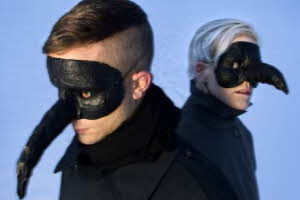
Alfred Soto: “Kabuki” is thrown around a lot, but for once it means something. This evokes grown men and women wearing contorted masks and squeezing strange noises out of their throats, to the accompaniment of exotic gewgaws. Not terrible.
[5]
Mallory O’Donnell: The Knife should be rewarded above all else for hoeing their own knotty patch of earth. But, loves: please don’t do so at the expense of what little sense of humor you already had. Sometimes it can be hard to hear the little band that had a song called “Lasagna” amongst all this fluttering modern paganism.
[8]