See? We do like music, honest!
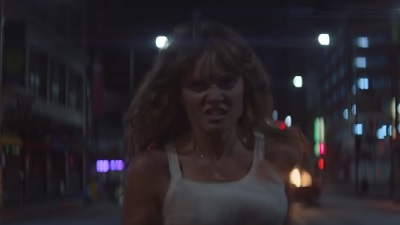
[Video][Website]
[6.73]
Claire Biddles: On the surface, Tove Lo is just another elegant waster of pop, simultaneously embracing and being jaded by the dark side of sex and partying. But unlike others who are now just going through the motions of wasted discontent — The Weeknd, Lana Del Rey — Tove’s integrity permeates through her clubbed-out persona. There’s a drive and a self-awareness to “True Disaster” that’s familiar to anybody who has sought release in the night out, with its stages of nihilism and self-preservation mirrored in the different tones she lends to the recurring phrase “I’m gonna get hurt” — certainty, determination, resignation. But seeking to get hurt doesn’t mean she’s playing the victim, which is another thing that makes Tove Lo feel authentic — she knows that hard-partying women aren’t inherently weak good girls gone bad; aren’t essentially “good” or “bad” at all. “We get dirty and we go hard” is standard party girl talk, but the follow up “some things we don’t mean” is more nuanced, more revelatory, and she’s not afraid of exposing the humanity behind the persona. When she announces “you’re just as bad,” she could be addressing her one night stand, but I like to think she’s talking to the female listener — a breaking of the fourth wall to remind us that sometimes this is what we want too.
[9]
Ryo Miyauchi: Synth-y is the new too trashy — just ask the Starboy. And Tove Lo lives for the disastrous lows, maybe more than the highs. Her voice sounds flatter than it should, and “zero fucks” doesn’t quite roll off her tongue, but her numbness to consequence only drives “True Disaster” even closer to the glorious edge.
[7]
Alfred Soto: The dark-hearted cousin of Ariana Grande’s “Love Me Harder,” this single begins with silence and proceeds with all the confidence its electronic clatter can muster. It has an appealing blankness.
[6]
Will Adams: Tove Lo’s fixation on the self-destructive and hedonistic has never really done it for me, but “True Disaster” is a fully realized illustration of it. Thanks to the synth throb and sudden dynamic changes, it’s the first time I feel the menace. But the real difference is Lo’s performance; the kicker is the bridge, where Tove Lo cries out “I’m gonna get hurt!” with glee. If ever there was a clear definition of dark pop, this is it.
[7]
Megan Harrington: I find “True Disaster” resonates well enough but isn’t a fun listen the way Tove Lo’s previous singles were. But fun was an expectation I put on Tove Lo, not one that she, either explicitly or implicitly, promised. I liked the way she dressed her problems up, on “Habits,” on “Moments,” and let them glitter and shine, beautiful gooey wounds. They were honest songs but they didn’t sacrifice any of their magnetism. “True Disaster” sounds more like scabs, the damage is visible but in a dull and crusty way. Problems are not supposed to sound appealing, and a person can’t bleed forever simply because it’s pretty. What Tove Lo offers with “True Disaster” is the truth without the patina of desire. This is the face we don’t want to see in the mirror, the one that looks back.
[7]
Thomas Inskeep: Awesome Moroder-esque throb, good songwriting from Tove Lo and Oscar Holter, and a singer who knows how to deliver her lyrics: this is what quality pop music sounds like in 2017.
[7]
Ramzi Awn: The pitfall of radio-ready music in 2017 is that a lot of it sounds the same. And the truth is that too much of it is unremarkable.
[3]
Micha Cavaseno: It’s hard to find the strengths in “True Disaster” that are solid enough to carry all the parts that don’t work. The bridge in particular has its cliff-hanger tension undermined by the bizarre “zero fucks about it,” a bit of a garish gesture to hipness (though not quite as silly as the “hide my feels” or the “get dirty/go hard” bits). And the exhaustion that billows through out the song really works wonders, but it’s this dated Drive-style electro pulse music that’s been done to death and become possibly the most revelation-by-numbers electronic pop style in the world right now. For all of Tove Lo’s strengths as a songwriter, her production makes her seem B to C-list pop, which when tied up in the more awkward attempts to fit in, makes her whole approach less misfit by standing out and more so by failure to comprehend when she’s not keeping up.
[3]
Elisabeth Sanders: Tove Lo remains the patron saint of self-aware self-destruction, somehow seeming powerful even within songs whose thesis is, essentially, please hurt my feelings because I’d rather feel that than nothing or something more boring. On other artists it can feel too much like self-pity or hyperbole; with Tove Lo, it always seems like it’s just the truth. While this doesn’t have the bloody edge of “Habits,” there’s an accelerating straightforwardness to it that feels a lot like walking to somebody’s house late at night when you know you shouldn’t and that’s one of the reasons you’re gonna.
[7]
Josh Winters: No one ever really talks about it, but the most heartbreaking aspect of enduring self-imposed suffering is how fucking solitary the whole thing can be. Feelings and emotions aren’t easily translatable for one to comprehend, especially when they’re colored and compounded by individual, isolated experiences. You can express what you’ve internalized through words and conversations and pray to God that the other person can empathize with what you’re going through, and if that doesn’t work, you can always take action. There’s still a small part of me that finds my foot firmly on the pedal, careening at breakneck speed with no end in sight, and looming in the rearview mirror is the threat of the thrill. Perhaps I should be concerned for myself with how intimately I’ve identified with “True Disaster” and the entirety of Lady Wood, but for the moment, I see Tove Lo, a woman in distress, and within that vision, I’m able to see myself.
[9]
Katherine St Asaph: Where Fiona was full as a tick, predatory and confessional, Tove’s full as a strobe light: not inward-focused but outward, on all whose realities need heightening. The track’s a gorgeously made-up mess. It thinks “I can’t hide my feels” and “zero fucks about it” are “real,” when what’s actually real is the palpable seductiveness of oncoming heartbreak; it commissions the shiniest electro-throb to hide the messiest background vocals; it professes heartstrings played faster and faster when the idea is steadiness, an implacable, controlled freefall into self-destruction. It’s not manic, it’s balletic: an exquisite final dance anyone can join in.
[9]