Not a Lady Gaga cover…
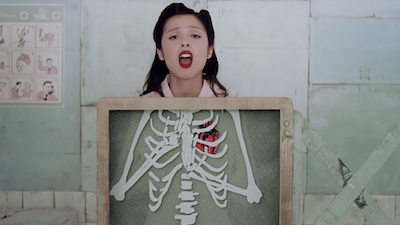
[Video]
[8.40]
[10]
Claire Davidson: Much has been made of the fact that “The Cure” has a near-five minute runtime — an ambitious tack for any pop single, particularly one released in our current age of atrophied attention spans and manufactured virality. That wider scale points to a real turning point in Olivia Rodrigo’s lyrical focus, too: whereas her previous ballads often lamented heartbreak or betrayal, “The Cure” alludes to a much deeper sense of ennui, one that manifests in a kind of numb detachment that won’t even allow genuine love from a partner to penetrate its walls. The source of that despair is a bit unclear; Rodrigo points to jealousy she feels toward her partner’s ex-lovers in the verses, but whatever deeper insecurities they illuminate remain unmentioned. That lack of deeper vulnerability — the kind that would earn all the bloody lyrical motifs on the chorus — leaves “The Cure” feeling oddly distended, especially given the spare acoustic jangle that powers the hushed verses. Rodrigo also strains for a breathy, barely-there falsetto during these more confessional moments, one that reads as far too overworked for such tender intimacy: her vowels are overripe and her enunciation is overly emphatic, flourishes that only point to the theater-kid maximalism that’s sorely missed here. Olivia Rodrigo is still a grade-A hook writer, though, and “The Cure” has a chorus that barrels through the track with such force that it essentially elevates the song by proxy, even if Dan Nigro seems hellbent on muffling the song’s eventual crescendo by muting the string section and percussion galvanizing its eleventh-hour climax. Perhaps deeper album cuts will reveal the risks “The Cure” ultimately abandons; one has to hope that evoking Robert Smith’s likeness this many times will result in his appearance on the tracklist.
[6]
Julian Axelrod: What starts out as a classic Olivia ballad with typically tasteful ’90s touchpoints (a touch of “Everlong” here, a dash of That Dog strings there) slowly blossoms into something more ambitious than she’s attempted in this mode. Sure, it reaches a bigger crescendo, but it’s also less vindictive, more self-excoriating, and altogether more emotionally open than her previous ballads. (And this is Olivia Rodrigo, so that’s saying something.) If she hadn’t already used the title, she could have called this one “brutal.”
[8]
Alfred Soto: I was not the first to note the resemblance of the opening guitar figure — low, hostile — to Smashing Pumpkins’ “Disarm.” Olivia Rodrigo thinks of “funny anecdotes” while Billy Corgan thinks in symphonies where mangled Wildeisms writhe in the whorls of notes. He fills space with his guitar and his desperate-toad of a voice; Rodrigo is at her best when she whisper-cries. In the end she inverts Corgan: the killer in you is the killer in me.
[7]
Josh Winters: The transition from assigning blame to accepting accountability is the hardest pivot any pop star can make. We’ve heard Olivia weaponize her rage against external targets, but by turning the blade inward here, she handles that pivot with devastating precision. It’s a stark, claustrophobic examination of the moment where intellectualizing your pain fails, and your body forces you to actually feel the collapse. The track opens on an isolated acoustic strum that feels like pacing around an empty room at 3 AM, but Dan Nigro slowly builds a wall of heavy indie-rock tension around her. When the bridge finally fractures into those throat-shredding, double-tracked vocal tears, it doesn’t feel like pop theatrics. It feels like a genuine panic attack captured in real-time, woefully mirroring the exhausting weight of a self-sabotaging mind. What elevates this for Rodrigo is her brutal but mature demolition of the ultimate romantic myth: that a perfect, well-intentioned partner can act as an external bandage for deep-seated internal rot. When she admits that flawless love cannot fix a broken foundation, the track hits with quiet, bone-chilling clarity. Someone can love you perfectly, but they cannot purge the poison from your bloodstream. Intimacy has limits, and nobody else can do the heavy lifting of saving you.
[8]
Nortey Dowuona: The poisonous nature of love is that it can clot into obsession or bleed out into indifference. The clotting forces you stick around them when you resent them, refuse to go anywhere without dragging or tagging along and unwittingly restrict parts of oneself to convince them to stay. The bleeding forces you away, makes you recoil from them when they clutch you, ignore their pleas, even cheat. And it cannot protect you from failure, from pain, from death. Love has a way of catching up to us at inopportune moments, in times of peril, during the most galling and diminishing points, and drowns us rather than lifts us up. Even love of oneself can become a prison of your own making. But we try, and try. and try again, the frustration and despair go hand in hand with the joy and excitement. We need love like we need hate. It fuels us, supports us, reminds us of the constructed memories, ideals and practices that make an us. But these practices have to go hand in hand, they are so often not co-mingling, and thus no matter how healthy the veins and arteries that carry the blood, if your ideal of love is meant to remain sedentary, they will clot and the body shall swell, and the thinners shall split you apart.
[10]
Andrew Karpan: My fondness for the latest Olivia record has not diminished after some hundred or so listens. Yes, it succeeds by sounding like a host of great ’90s rock records, jammed together like diseases in the immune system doorway of Montgomery Burns, blasted to eleven, a kind of Rosetta Stone of moodiness, three different languages of post-grunge anger and angst translated with perfect lucidity. It’s the Smashing Pumpkins, it’s the Cranberries, it’s the Foo Fighters, it’s even mid-career Placebo too, but who cares; that is only its architecture, the outline of a sound filled with all those perfect objects from the light purple Olivia project, from the theater-kid perfect wailing on cue to the well-placed fuck, a textbook filled with so much reference that cites further material, all from the handbook of the totally known and much-passed around and it sounds like the felt marker tip on the crease of worn dog-eared notebook paper, containing only those secrets we all know, memorized and forgot and can remember all over again. From the album, one imagines the critics will pick different songs, records with more complicated and arch chord progressions, evocative in whatever particular way or personal in less direct ways, but like everything else, it will never be “the Cure.”
[10]
Will Adams: Olivia Rodrigo usually eludes me, her work often leaving the impression of a perfectly stuck landing: technically on point, and that’s it. On paper, “The Cure” is primed to be more of the same, a slow-building ballad with a familiar lyric conceit. But it clicks from the first line, in which Olivia makes clear the problem with this dying relationship is her, or, rather, her mind. By the time she asks, “why can’t you come stitch me up,” she already knows the answer. That’s when the song launches into its climax, all lachrymose strings swoops and galloping drums, and the emotional catharsis is earned.
[7]
Jacob Sujin Kuppermann: I’ve long held that Olivia Rodrigo’s ballads have been the most boring part of her discography (one major early exception aside, of course). Whenever she goes slow she loses the things that make her music so compelling, the clarity of her craft buried under a mountain of maudlin gestures to big feelings. “The Cure” does not, exactly, break from that tendency — I would not say any song that uses strings the way this one does avoids maudlin sentimentality. Yet “The Cure” is obviously the best ballad she’s written since “Driver’s License,” succeeding precisely because it leans into its most overwrought qualities. This is a big-feeling song about big feelings, the kind of thing that many artists, Rodrigo herself included, tend to couch in irony or dilute in cliché. Here, though, you can feel the weight of every line, the build up and repetition never dulling the impact.
[8]
Al Varela: I’ve always considered the greatest musicians to be artists who grow up with their audience. Those old songs will never lose their power, no matter how much you grow past them and the emotions they encapsulate. But if an artist sticks to that bread and butter a little too long, eventually you’re gonna want a little more from them. It doesn’t even have to be a drastic change, just an acknowledgement or a change in their demeanor that makes you want to continue following them and their journey. I’d argue this is something Taylor Swift has perfected, even during her worst eras. Now I think Olivia Rodrigo is on her way. It feels like her whole career was building up to this song. After two albums of thinking love will fix her, she finally finds a guy who’s willing to stick with her in the long run. No more wishy washy back and forth hookups, no more abrupt breakups, no need to convince herself that maybe this guy is the one, because he might well be! And yet, even amidst this romantic bliss, Olivia still finds herself falling into her old habits. She thinks more about the girls he’s dated before her than she does her actual boyfriend, she’s still cripplingly lonely even in a long-term relationship, and even when this guy does his best to quell her insecurities, it all feels so temporary. He can help, but he’s not the cure. The real panic and desperation in Olivia’s voice over this phenomenal swell of strings and pianos really sells the panic of realizing your depression doesn’t just go away because your life is going well and you got what you wanted. It’s a constant battle, one that Olivia might not be prepared for, especially as a girl who, for the past two albums, sought out love and companionship as the solution. In a few albums, maybe she’ll learn to live with it, or find ways of dispelling those thoughts about putting the burden on her partner. But for now, it feels like the honeymoon phase unraveling. I can see why this is the album centerpiece. In a way, it feels like a major turning point for Olivia’s whole career.
[10]