As an independent music blog, we don’t really have the resources to do that, Ms. Hobert, but we *can* send you a strongly worded letter…
[Video]
[7.19]
[8]
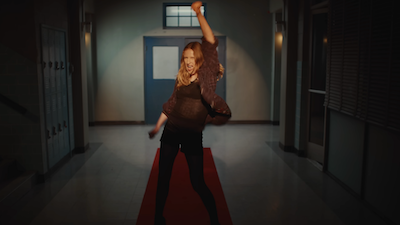
Ian Mathers: The Pop Star Looks Discourse is exhausting, extremely well-trodden ground, and frequently disgusting (god forbid some of our pop stars look both look like regular people and appear to be uncaring about that fact). It’s a shame it’s settled on Hobert, because what we should talking about is what a good, smart, funny, catchy songwriter she is (as well as directing and editing the very good and funny music video). As with “Thirst Trap,” “Sue Me” offers a distinctive and intensely relatable (at least for this mid-looking guy) perspective on a pretty standard relationship topic, with fucking your ex taking the place of having a crush. Seeing that Hobert wrote it after sleeping with an ex who had more feelings than she did adds a piquancy to the buzzing synthpop production, but even without digging into the lyrics, “sue me I wanna be wanted” is the kind of earworm nearly everyone I know is going to find hummable for multiple reasons.
[10]
Alfred Soto: I wanna be wanted too! Especially by strangers. I also like it when an act finishes a song before releasing it to a discriminating audience.
[3]
Nortey Dowuona: Audrey and my brother are the same age. Unlike some of my other comparisons with my youngers who were born the same year, Audrey and my brother both display that polite earnest affect that is easy to like. Unlike my brother, in this piece Audrey pulls off that affect to pointedly display a sneering contempt for her ex, one that seemingly gets filed away in order to consider fucking him once more. Producer Ricky Gourmet of this buzzy house party rager and slinky pop folk duesenburg added the lyric “In my bones, yeah, I know it’s platonic (platonic), but fucking your ex is iconic (iconic)” which to be frank, isn’t as fiyah as “just me or does he look amazing when he’s all in his Amazon Basics?” But Audrey, like my brother, is still a gentle soul, so she picked the lines up and sang them with gusto. As does my brother at a bar in Somewhere, USA.
[7]
Hannah Jocelyn: Sidney-ish.
[6]
Alex Clifton: I don’t get a lot of dopamine from new music these days. Maybe it’s because I’m not seeking it out as actively as I did when I was in my 20s, but I’ve found myself relying a lot on old favourites this year. That was the case until Audrey Hobert crash-landed into my life a couple months ago. Who’s the Clown? has not stopped being in rotation. It’s a collection of pop music that feels like it was genetically engineered in a lab for me: brash hooks, an awkward and charming sense of humour, and fun production details (the gunshots here get me every time). I like hearing people have fun when they make music, and “Sue Me” is a perfect example of that. It’s endlessly catchy and has yet to get old for me after many, many replays. I’ve also not stopped thinking about that outro for months: “I’m sorry that your dog died / Sorry that I’m, like, your dream bride / You’ll go to heaven and I’ll go to the hell in the meantime.” How can you not want to scream that aloud? In a year full of terribly boring pop charts, Hobert has become a life raft for the kind of pop I’ve been longing to hear.
[10]
Kayla Beardslee: This would be an excellent song for a movie soundtrack but is just okay as a standalone. (Hold on, what’s that? It was featured on a TV soundtrack? Well, well, well.) I did bump it up by one point after a few listens — the pep is mostly cuter than it is grating — but please, Audrey is singing “sue me” in the same tone that she would use to order a latte. Yeah, I like my hooks to have a bit more conviction — sue me!
[6]
David Allun Jones: Look, emotional roller coasters about whether it’s a good idea or not can be dealt with later. Sometimes you just want to get your smash on without the work of trying to figure out someone new, so why not stalk an ex at a party and rope them into another round of bumping uglies. Love how Audrey cares so little about the past and future heartache she’s responsible for with this partner (reasoning with her sins with a delightfully pat “I’ll go to hell in the meantime”) and how the song’s dry percussive thwack and needling multi-synth burbles excellently detail the kind of wham-bam, emotion-less hump fest she’s craving. Even the way she repeatedly chants “I wanna be wanted” feels matter-of-fact all the way through, whereas far more histrionic vocalists would’ve tried to shade those same four words with an assortment bag of sentimental subtexts. Somewhere Taylor Swift is beaming with pride at yet another of her offspring (and probably a little envious she didn’t craft this earworm first).
[8]
Jel Bugle: Is this a Taylor Swift tribute? Liked the trashy croaky synth sounds (again; maybe I just like trashy synths); they were the best bit.
[6]
Tom Feckerdt: Uneasy and squelchy in sound, “Sue Me” takes a specific experience (running into your ex at a social gathering and saying “fuck it”) and, instead of having us be in the moment with the narrator and this other party, the song presents the whole exchange as something that’s already happened. We’re not in the room watching this unfold, rather we’re being recounted, in present tense, what went down, with the framing positioning us within the narrator’s internal logic, in which she pairs an incessant justification for her actions with a knee-jerk reaction that actually there’s no need for a justification — both ideas summed up in the titular line and explored in its note-perfect backup harmonies. Through this, Hobert is able to express the real anxiety and thrill that comes with this allegedly self-destructive indiscretion while also sounding low-key detached and distant, and seeing how the balance tips one way or the other is the song’s main dynamic success. That’s felt in how the harmonic baseline gives us a familiar progression we intuitively understand, and having that backbone be in service of essentially one line (sung in a frantic cadence) means we’re hooked on seeing how and when said line is going to be interrupted, altered, or even shaded and harmonized in a different way: tossed off, rushed, insistent, and so on. And since the production only gets bigger and louder, that push-and-pull between the depth of desire and the instinct of self-awareness only grows more intense and neurotic, so of course, when the narrator finally unveils her true feelings (swapping “I wanna be wanted” to “I gotta be wanted”), the song has no choice but to end. A quality sugar rush and a great capital-Z Zoomer text.
[8]
Taylor Alatorre: Audrey Hobert is fighting an eternal war against the person she was four seconds ago and I vibe with that heavily. She restages the events and almost-events of her life from an isometric perspective with testing cheats enabled — “fucking your ex is iconic,” she narrates, before taking a quick screenshot for posterity and loading up an uncorrupted save file. “Sue Me” is packed full of lyrics like these, each competing to be the one that seizes you by the shoulders with its sardonic twentysomething insight. None of them quite get there, but that’s okay, because the cumulative effect is to drench the listener with a firehose of poised and practiced self-deprecation. The underlying electro-glam stomp, pointedly dated as it is, prevents her routine from curdling into cool-girl false modesty. If Hobert’s merely playing the fool, it’s because she has the relevant life experience.
[8]
Jacob Sujin Kuppermann: Audrey Hobert is a breathtakingly skilled technician at the level of the syllable. Her time in the songwriting mines has given her a precision unmatched in the modern pop aspirant set at fitting together ungainly strings of sounds into single lines, and here she’s figured out all sorts of dark arts; the bridge rhyming “dog died” and “dream bride” is just icing on the cake. She’s not quite yet figured out how to structure a song yet; both this and “Silver Jubilee,” my favorite single of hers yet, feel somewhat like clever pre-choruses stretched to a three minute breaking point. But for now, at least, she’s a good enough hang on the micro level to excuse some bigger picture muddiness.
[7]
Dave Moore: Haven’t totally decided how I feel about Audrey Hobert’s syllable storms, the way she patters through verses and choruses daring you to distinguish them, like someone muttering to herself anxiously at the bus stop. It would require me to parse the words, an effort the cyclical little ouroboros designs seem to deter until you land with a thud on the occasional hashtag — toxic, iconic. Toxic, maybe; iconic, probably not.
[5]
Julian Axelrod: Do the Hobert Haters realize how lucky we are to have a word-drunk nepo pop prodigy tracing a trenchant tribute to feral desperation over saw-toothed synths and stomping the stage like Tina Weymouth ate David Byrne in the womb? Or do they just not care?
[9]
Katherine St. Asaph: Not the first song called “Sue Me” from a children’s TV alum, nor even the first song called “Sue Me” from a children’s TV alum with a wry sense of humor. Sabrina Carpenter was a sitcom actress whereas Audrey Hobert was a sitcom writer, and fittingly, Hobert’s “Sue Me” has a less showy hook but quippier lines.
[7]
Claire Davidson: I gained a newfound appreciation for Audrey Hobert once I listened to Gracie Abrams’s Daughter From Hell and realized that “Minibar,” the lone track co-written by Hobert, was conspicuously the only song with a vestige of levity or humor. Of course, I had already liked “Sue Me” well before then. Its jokes aren’t terribly cutting-edge: in pleading for a hook-up with her ex, Hobert skewers the therapy-speak and wellness regimens common to public displays of growth, but that’s low-hanging fruit, borderline uninspired on paper. No, what makes “Sue Me” compelling is how determined Hobert is to push that desperation to its limit, fusing her words in breathless gusts and practically groaning her way through perfunctory pleasantries. (When she whines “and I’m sorry that your dog died” on the outro, you can almost see her rolling eyes.) Hobert is well-aware that she doesn’t actually have any lingering affection for her ex; indeed, she’s long come to terms with her flagrant horniness, and is so bored of masking it that she’s now moved on to sheer exasperation. It’s then that the song’s farcical charm emerges, as Hobert drools over her ex’s “innocent basics” and exaggerates their every encounter as a cosmic sign. That greater sense of myopia does make the song a bit dry: the track’s buzzy synth line and crisp swipes of percussion are as sticky as taffy, but without more instrumental detail, “Sue Me” ultimately reads more like a comedy sketch than anything else, albeit a very canny one. Sadly, I doubt Hobert will last long as a mainstream figure: she has openly stated that she only obtained a publishing deal thanks to her success writing with Abrams, and given how cruelly certain sects of the Internet have discussed her appearance, I struggle to believe she’ll build the support necessary to sustain a dynamic career. Nonetheless, “Sue Me” remains a nifty little diversion, and the music industry has certainly given us far worse in the name of novelty.
[7]
I was going to start by saying there’s something ineffably familiar about the bassline, but actually it’s completely effable, because I have definitely heard this song before, so I appreciate the opportunity to give it some real focus 🙂 it’s amazing how this doesn’t come off as cloying, twee or too tee-hee from a “not like other girls”, which probably anyone else doing this would have perpetrated [8]