By Charles Dicken…
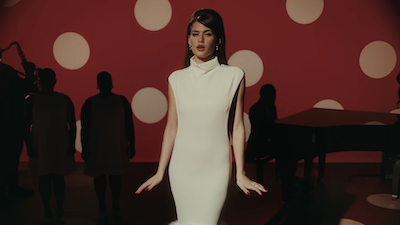
[Video]
[4.07]
Callie Petch: I get why Sienna Spiro has gotten big. Britain has a long-standing weakness for retro-soul performed by technically proficient singers, usually female, who belt non-stop because in our post-Pop Idol/X Factor culture, Most Singing is easily misconstrued as Best Singing. Adele has taken another of her customary half-decade breaks, RAYE made it clear she’d rather be a significantly more interesting artist than this, and so there’s a big gap in the market for someone to fill that Amy Winehouse-adjacent hole. Spiro even has the Duffy haircut to go with the Iceland own-brand music, and she’s so privileged that you could almost call her the British Stella Lefty. Yet I still don’t get how Spiro’s gotten big enough to finally vanquish “Rein Me In” (with the aid of ACR) from its death grip on the UK #1 throne. “Great Expectation” isn’t much of anything, just a fill-in until Adele comes back from buying cigarettes. It’s just so bland, and I get that a certain level of blandness is inherent to this kind of music — designed to slot equally unobtrusively into Radio 1, Radio 2, Spotify Top Hits, and supermarket PA playlists — but that doesn’t mean it can’t push me to feel. I don’t feel anything here, despite Spiro’s extremely pitchy vocal histrionics trying their damndest to force it.
[4]
Iain Mew: This is not a song shy about its inspirations. Sienna Spiro sings the first verse like she’s ready to launch into “Set Fire to the Rain” at any moment; as the retro backing kicks into full Back to Black gear in the second verse it’s helpfully lampshaded in the words: “it’s black and white/but I go back…”. It’s not original, but it hits the marks well enough. Elsewhere, “Great Expectation” gets in its own way, like in the title phrase. There must be a reason why it isn’t just the Dickens title — SEO separation? One fewer consonant sound? — but “the great expectation of you” is distractingly odd when “all I need is my great expectations of you” would seem more straightforward and personal. The kicker to that one comes at the end of the song, when the drawn-out switch to “all I need is you” really needs some “Video Games” style pathos, a sense the narrator has slipped fully into delusion, to work. The professional vagueness has left no room for it.
[4]
Tom Feckerdt: Despite “Die on This Hill” not making a good first impression, I thought Spiro’s schtick of taking Lana Del Rey’s early material and saying the sadomasochistic part as loud as possible would have some kind of residual novelty effect. Two songs into her repertoire (and a couple more I reluctantly checked out for this blurb), that formula is shown to have a low ceiling. There’s just very little to do as a listener when her singing and writing are both so upfront, with no room for new layers to develop as the song goes on. All this drama is sung so carelessly: Spiro’s voice cracks and shifts into melismas at random but never for emphasis, because the totality of her voice and the way it’s produced make such nuances borderline impossible. Speaking of, I’ve no idea why they got busywork handyman Omer Fedi as her main producer; adult-alternative balladry isn’t his field of study. And if the words were meant to do any heavy lifting, they don’t. I audibly groaned when I realized Spiro was going to change “All I need is the great expectation of you” to “All I need…is you” for the outro; that’s just the hackiest shit imaginable. The eyeroll-worthy cultural references sprinkled throughout (Charles Dickens, Nina Simone, “Tracks of My Tears”) do nothing to paint a picture of where the narrator’s head is at — another symptom of the cultural malady of pop references as signifiers of respectability, though neither the first nor the worst.
[2]
Jacob Sujin Kuppermann: It is not sacrilege to interpolate. Referencing the greats has always been a part of the soul-pop artistic lineage that Spiro is angling to join. But the risk of, say, referencing a late-period Nina Simone obscurity as the first line of your soaring chorus is that people will be inspired to instead listen to Nina Simone, or perhaps even worse, draw comparisons between Simone’s wily, playful performance and your own rote replication of the Adele-Winehouse school of nu-soul balladry.
[4]
Alfred Soto: As a show of carbon-frozen soul emoting, “Great Expectation” sets up a minor one. Sienna Spiro has studied her sources: Adele, Amy Winehouse, even Julia Fordham. The cracks evoke Dua Lipa at her giddiest. I don’t sense much euphoria in Spiro’s approach: she’s in her house because she fears exposure.
[6]
Claire Davidson: “Great Expectation” is a stark betrayal of how reactively Sony signed Sienna Spiro to a publishing deal, capitalizing on her fleeting virality without much of a plan for her music beyond exploiting her tremulous alto. The song is a retread of “Die on This Hill” at a faster pace, as Spiro wearily takes stock of how reliably her partner disappoints her and still vows to stay in spite of herself. She at least has a bit more self-awareness this time around: she surveys the anxiety she’s displayed throughout her relationship history, clinging to men who didn’t fulfill her just to avoid confronting her own insecurity. But while the lack of stubborn grandstanding is an improvement upon “Die on This Hill,” “Great Expectation” still loses something in abandoning its predecessor’s contemplation, glossing over the hurt in her lyrics for a midtempo, morose trudge. Spiro’s vocal affectations are in vain without a deeper sense of emotion undergirding her tricks; “Great Expectation” is all choreographed gesture.
[5]
Harlan Talib Ockey: Sienna Spiro’s vocals flip between “swallowing the words” and “full throttle belt” without any gradient or adornment. The lyrics are flat, largely metaphorless. The band and backing vocals are somehow mixed into porridge.
[3]
David Allun Jones: 2026’s Best New Artist Grammy shoo-in and star pupil of the JHud School of Louder-Than-Louder Singing, Sienna Spiro lands here like those contestants on The Voice who master all the right vocal acrobatics but fail to turn a chair because they sacrifice emotional connection to the material. Note the moment at 2:09 right before the final chorus when the music drops out and Spiro goes for the climax…but it doesn’t quite burst into technicolor, because she’s spent so much of the song already at edge of range. I am invested in the subtle colors provided by the BGVs, the teasing of some cool retro girl group gold hidden within the song’s seams. Key word there, Sienna: subtle.
[3]
Nortey Dowuona: Michael Pollack w Khalid: Khalid is at each turn perturbed and frustrated, but ultimately dismissive and annoyed; he knows what bro’s about, knows what bro really wants, and is just so tired and done with his nonsense he offers him a false number and dips. He’s expecting to be disappointed and led on, but he’s found a way to tolerate it. The song’s constructed as a kiss-off, not a lamentation. Michael Pollack with BoyWithUke: BoyWithUke is frustrated and jealous, but mulling it through passive aggression and barely veiled threats. He knows what she’s about, but he can’t see the point of not trying to pull her card. There’s a smugness at being proved right in his assumptions, but a pissy attitude that comes from not being able to disprove his quietly expected betrayal at her hands. The song’s constructed as a lamentation, not a kiss-off. Michael Pollack with Sienna Spiro: Sienna is devastated, then contemplative. She started thinking this person was meant to be a great love, a person who swanned in and spun her right round, but disappeared from view, leaving her confused and frustrated just as Khalid and BoyWithUke were. Unlike them, Sienna is fine to remain comforted by the illusion being sold; she is not furious like Boy nor resigned like Khalid. She drinks in her fantasies and delusions, and waits at the window a bit longer.
[5]
Andrew Karpan: I like the idea of Shaad D’Souza calling the rubbery determination in her songs the product of a certain kind of “lyrical stubbornness.” We all should be so stubborn, should fall so determinately for a certain kind of ambiguous yearning. It’s all rather silly if you think about it — “Sing just to know I’m alive,” who cares? — but it’s the power of Spiro’s voice that you don’t think about it at all.
[7]
Jel Bugle: It’s got a bit of life to it, even if the Brit School vocals (she didn’t actually go to the Brit School) grate a little. Grate Expectations?
[7]
Katherine St. Asaph: I played this for my snake, also named Sienna. She wriggled around the Delete key en route to ESC then somehow closed the window.
[3]
Charlotte Gaze: Like downloading “soul” on a virtual machine. I understand that I’m meant to be moved by this vocal performance in its cracks and imperfections. It has been painstakingly crafted to elicit the optimal emotional response from the listener. I can’t say that it succeeded. But I identified the correct response, and I’m sure the great minds behind this song consider that good enough for them!
[1]
Al Varela: I don’t mind the music consuming audience being really into easy listening shlock; I just think there’s way better easy listening shlock out there. This song doesn’t have the gross implications of “Die On This Hill,” but there isn’t anything else it can offer you. Listen to Adele again, or Teddy Swims, or Olivia Dean. I’ll even take Alex Warren at this point. Just give me anything.
[3]
shouldn’t this be rule #1 on the list of things you don’t call your first single? because you’re really just setting yourself up here…
I hope the women who seem to be celebrated for singing like this have good voice care, I can’t imagine all that cracking is good in the long run [4]