In which opinions, as they say, differ…
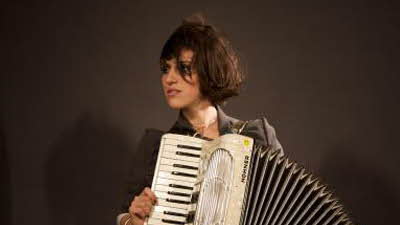
[Video][Myspace]
[5.62]
Brad Shoup: It seems the Trio’s jazzy chamber-pop has reached critical density. The eased-off approach of Mizraim now takes on a mass of circular guitar, woodwinds, and what sounds like a vibraphone. All this is added, mind, to a piano part that’s eerily akin to the intro of Van Halen’s “Right Now”. It’s a fine mix, if a lot to take in, but Balency’s callow voicing are too much for me. The unmoving melody becomes one repetitious element too many. Her fondness for musique concrète exhibits itself in the engine noises at the end; it’s a shame the reveal comes so late.
[5]
Michaela Drapes: Yé-yé en Español?! Wish I’d thought of this first, and I’m kind of embarrassed that I’m only hearing of Ms. Balency now. And yet, for all my enthusiasm, I’m not entirely sure that her alchemy is working here. I realize she’s trying to layer spare vocalizations over lush instrumentation, but it ends up sounding a little too generically bland and something’s naggingly out of proportion. I’m almost certain she’s got the power to either blow up the vocals a bit more to scale or drop back the fruitiness of the arrangements a tad; either one is bound to pull this all into a bit more focus.
[6]
Alfred Soto: The trio saws away rather too enthusiastically in the last third, like a noise rock band treating the vocalist like a third guitar. The chaos matches Balency’s own, but it doesn’t cohere into thoughtful patterns.
[5]
Iain Mew: Too slippery and ethereal to get a grip on for much of its length, but I’ve had the gasps and leaps of its chorus ever since the first couple of listens. The way that it sneaks up so slowly and quietly is very deliberate, too, working to lend an additional force to its closing frenzy and its desperation, flute and misfiring engine combo.
[7]
Edward Okulicz: The opening of this is beautiful, just beautiful, and Hope Sandoval or someone else with a candle of a voice could have made it a [10]. But Andrea Balency’s voice lapses into sounding like a grown woman imitating a baby’s wail too often to suit; the song’s called “Lover,” remember.
[5]
Jonathan Bogart : Somebody somewhere said jazz, and it was called “Lover,” so I was actually kind of hoping for an oblique take on the Rodgers & Hart standard. But the kind of tropically overheated chamber-pop I got instead has its own pleasures, of which Ms. Balency’s kind of thin, kind of ordinary voice is the least.
[7]
John Seroff : Balency’s voice is guttural, precise, enigmatic and gorgeous; I was so taken in by the balletic qualities of the vocals that a half-dozen listens passed before I finally determined that the bulk of the song isn’t even in English. The restrained blend of gothic and chanson that drives the melody makes an excellent bed for Balency to languor over. “Lover” is a subtle and delicate petit four among the Jukebox’s usual Twinkies.
[7]
Jer Fairall : Aimless and drowsy where it seeks to be atmospheric and etherial, though to be fair a voice this sickly could probably leave Wild Flag sounding comatose.
[3]