The Singles Jukebox has a lot of opinions about the SUPER AWESOME Fiona Apple…
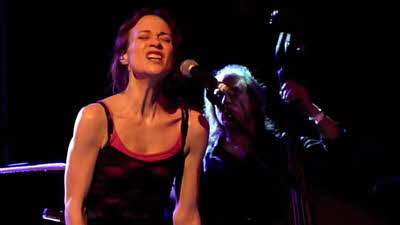
[Video][Website]
[6.22]
Katherine St Asaph: The music-box piano is there to trick you. The little whims of the first verse are there to lull you into false security, to muddy your memories and make you forget Fiona Apple’s never done placid or twee. This lasts about three lines before she fucks with the chords, before she shoos the butterflies offstage to talk about being what she mustn’t be and shoving feelings beneath her skin and scrambling her guts like eggs. There’s amusement here, but there’s no irony; she means everything. She means it when she says she’s at war with her brain, and she means how she sings it like a reveille or a one-woman shanty (and earworm), first almost a cappella then with a battle march and drumrolls by her side. She wants to feel everything, and when she sings it like there’s nothing between her nerves and the air, you know she means that too. Anybody can confess, and most can learn to be confessional. But to be this open, this exposed, so rarely happens.
[10]
Jamieson Cox: Fiona Apple’s return to live performance in March was met with the sort of breathless acclaim that inspires heart palpitations in attentive music fans. Nitsuh Abebe called her “hyper-alive, working at a level of intensity that is rare;” Matthew Perpetua made the claim that “it is hard to imagine that any other vocalist alive and working today can match her in this moment.” It’s difficult for listeners stuck at their desks to digest these incredibly positive dispatches from the front: how can we compare, contrast, and quantify this stunning vitality, this astounding intensity? It’s an impossible chore, but “Every Single Night” offers a small taste of what Fiona Apple is capable of, nearly 16 years after the release of Tidal. There are glimpses of her newfound power and restraint as her voice quivers from the force of the emotion palpable in each new phrase, and she places herself firmly in the forefront by opting for a spare, twisting arrangement. But my personal favourite moment comes after ninety seconds, when she offers a tidy, striking distillation of her career in music in one line: “I just wanna feel everything.” In 2012, it sounds like she’s closer than ever.
[8]
Alfred Soto: She’s been listening to Joanna Newsom and Merrill Garbus and good for her; as her craftsmanship got more impressive so were Jon Brion’s Revolver-isms. But a single this ain’t.
[5]
Josh Langhoff: “Webber and Sondheim, watch out,” warned Christgau in ‘99, and I’m genuinely surprised Apple hasn’t written a musical in all that time. Based on this piece of… unique… craftsmanship… I suggest she adapt E.L. Konigsburg’s young adult classic (George), about a gifted and troubled boy (Ben) with a “funny little man” (George) living inside him. George specializes in lewd jokes but also acts as Ben’s conscience, advising him to stay away from the older kids trying to manufacture LSD in the science lab. “I really saw myself in Ben’s struggle,” Apple will say in an interview, “because every single night’s a fight with my brain.” When asked about her greatest struggles, Apple will admit, “I can’t fit the feelings in” and “Sometimes I just have too many ideas percolating my mind.” (George): The Musical will naturally be terrible, but truth and the theatre are terrible mistresses.
[3]
Anthony Easton: I thought that we had gotten rid of her. After 7 years you’d figure she would have just gone away forever, but no: back and worse than ever.
[0]
Zach Lyon: At this point I’m not sure Apple can ever release a song I won’t enjoy on some level. Like always, she doesn’t seem to care much at all how she’s received, which I don’t see as an inherent positive but an ever-important aspect to her music, seeing as her relevance(/”buzz”) never seems to last more than a few months after a new release. It’s almost inevitable that any trace of this record will be forgotten very shortly. That she treats that fact like Fagen and Becker did in the 70s (retreating back into the forest with a smile) doesn’t hurt her image as our beloved Composition notebook poet; but like always, she’s more pop than art-house here, if you give it a second glance. No matter what she writes, you can expect the arrangement itself to stir your inner aesthete. The lyrics themselves, I’m still anticipating.
[8]
Brad Shoup: It sounds like a scene-setter, even though we’ve been clearing the stage for this record for some time. Perhaps it’s more of a pause, a caesura between the music we hear in our heads and what she’s about to deliver. Nothing here is notably surprising, although Apple’s hiccups provide a neat mix of mock-grandiosity and humor. The lean arrangement — part Jon Brion subzero lounge tinkle, part Nilssonian late-night whimsy — is reliant on her boxer’s dance of a vocal. It’s there, it’s enlivening, and it’ll do for the moment.
[7]
Iain Mew: Here is where I admit to never knowingly having heard Fiona Apple before (yes, I am that young and incurious and British). Her voice is much more difficult than I expected, somehow, but the song is frequently enchanting in all of its diversions and flaps in different directions like the butterflies of its first verse. As sweet as it sounds on the surface, its refusal to ever quite settle is a good fit to the internal struggles with brain and body of its words too.
[7]
Jonathan Bogart: “Every single night’s a fight,” she sings, “with my — ” and the stairstep “brain” that follows is part exorcism, part incantation, part showing-off vocalese. It also happens to sound a good deal like certain of the Native American ceremonial chants I always feel weird about including in my diet of old ethnographic recordings, because it feels like a violation to listen without understanding. Which is also, hit singles excepted, how I’ve always listened to Fiona Apple. Some barriers disinvite crossing.
[8]