Per this controversy score, only some of us…
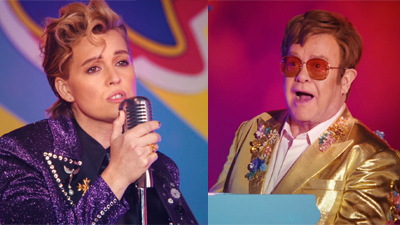
Claire Davidson: A better question: who believed in this song? While Elton John’s quest to anoint a new generation of musical gay icons (queer and straight among them) is very noble, and he just receieved an Ocsar nomination for a different Brandi Carlile collaboration, Carlile herself is not exactly the best match for Elton John’s brand of showmanship. Listen to any of Carlile’s solo work and you’ll find that her strengths lie in her plaintive, earthy soft-spokenness, a profile more suited to “Your Song” than “Goodbye Yellow Brick Road.” Even if she were better-suited to such bombast, “Who Believes in Angels?” does both she and John a staggering disservice, placing her voice at the front of the mix to distract from how limited her now 77-year-old duet partner’s vocal range has become, as John forces a wavering bellow that wholly clashes with the song’s theatricality. What a disastrous mix it is, too, multitracking both singers’ voice to no end against instrumentation that blends the harshest, most most electric guitar and synths tones imaginable for this sort of balladry, causing an already an overwrought venture to curdle into pure noise. There’s no need for this song to be five minutes long, either; the extended outro continually grasps for a grand finale it can never reach, in part because the chorus has already sucked the air out of the room. As if all of that weren’t painful enough, though, while I know lyrics are essentially superfluous for this kind of late career release, this song’s concerns with legacy and — God forbid — the afterlife are so broadly sketched that they only underscore its sense of fraudulence.
[3]
Jacob Sujin Kuppermann: This is moderately less theme park-ish than the Dua Lipa one — instead of just doing karaoke this attempts a through-the-mirror-twice pastiche, Elton-doing-someone-doing-Elton. Bernie Taupin’s there, but so is Andrew Watt, the patron saint of nostalgic self-reports (he was on “Abracadabra,” too! Busy year!) It’s a pointless exercise: the way the song doesn’t quite crescendo but instead just peters out is indication that no one involved has a tremendous amount of faith in what they’re doing. And yet I can’t help be charmed by this, Brandi Carlile’s vocal performance taking on just enough of Elton’s trademark drama to match his still formidably portentous voice. It’s ridiculous, but he’s always been ridiculous. Why not have one last act?
[6]
Nortey Dowuona: Me to Watt:
[9]
Harlan Talib Ockey: Musically, this is the best possible version of exactly what you’d expect. The lyrics, meanwhile, start out with some promising narrative ideas before totally dissolving into a soup of cliches and koans; “end of days”, “die on that hill”, “Mercury in retrograde”, bark/bite, etc. I have no idea if this is trying to say something, but it’s nice to listen to.
[6]
Alfred Soto: Elton John’s affinity for mopey plaints will never efface the weirdness of his 1971-1976 run. Even Brandi Carlile knows.
[4]
Julian Axelrod: Now I get why the Tammy Faye musical closed early. This would win a Golden Globe (derogatory.)
[3]
Will Adams: A bit early to confirm the song and performers for the “In Memoriam” segment of next year’s Grammys, no?
[3]
Ian Mathers: I know this is more “authentic” than that deliciously ersatz, patched together PNAU thing; but just like I prefer Kraft Dinner to middling homemade mac and cheese, I’d rather listen to “Cold Heart” than this snooze.
[5]
Jel Bugle: Don’t bore us, get to the chorus! Yeah, this is pretty good. Did we need another soft rock duet? Did we need any other song? Possibly not, but we’ll keep getting them for evermore.
[8]
Taylor Alatorre: With a title like that, the song couldn’t not hinge on the chorus, which awkwardly strains for grandeur rather than snugly inhabiting it in the manner of Elton’s classics. And yes, that’s a weighty legacy to live up to, hence why Brandi Carlile is called in to do most of the lifting here, to avoid revealing just how many cracks have set in. The effect, though, is to largely reduce her nominal duet partner to a late-song jump scare in the manner of his Fall Out Boy collaboration. One must assume that, as one of the songwriters, Elton is fine with this division of labor, even if it somewhat conflicts with the song’s promotion of risk-taking in the quest for secular immortality. The chorus doesn’t conflict with that message, though, no matter who sings it; if it’s failure of overreach, it’s at least a noble one.
[3]
Katherine St. Asaph: A deeply felt missive against respectability politics and lying to oneself and polite inaction (“if you’re not swinging first, you were never in the right”) that is… timely. Also, I am a predictable person who responds predictably to certain cues, like a song suddenly annihilating its previous emotional ceiling to reveal a chorus a thousand times bigger. (It’s perhaps not a coincidence that the title evokes an ABBA song.)
[9]
Melody Esme: I don’t know the exact level of theatricality a song has to hit in order to completely lose me. All I know is that Chappell Roan hits the sweet spot of theater kid gay to actually work and make compelling art, while this one goes right over the edge into unbearable schlock. The album cover is an eyesore. It fits this song perfectly.
[2]
Mark Sinker: justice for kiki dee
[3]