There are many routes to a hit single…
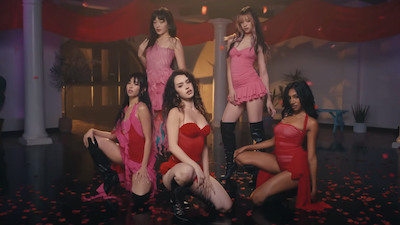
[Video]
[4.00]
Al Varela: I dunno. I think if you’re going to make a K-pop group for an American audience, you should at least give them songs that embody the spirit of K-pop and why it’s become popular enough to cross over into the US, rather than leftovers from non-K-pop artists.
[5]
Joshua Lu: “Gabriela” was apparently shopped around starting in 2018 (back when the industry was capitalizing on a post-“Despacito” world), with Anitta, Rita Ora, and Little Mix all passing on it. I can imagine they all gave it up when faced with the futility of trying to sell the line “back off of my fella”. Katseye do their best to present that as sultry and badass, but it still sticks out as a goofy aberration. Maybe it’s for the best; the song is otherwise wholly forgettable.
[4]
Kayla Beardslee: I’ll start buying into Katseye when they release a song that doesn’t sound like a reanimated corpse. This is a Rita Ora reject from 2019, for god’s sake! Even Fifth Harmony showed more life than this sometimes.
[4]
William John: Quaint in the sense that it could easily pass as a CNCO track from eight or so years ago, “Gabriela” moves at a pleasant enough lilt, but offers little in the way of thrills. While “Gnarly” was a garish display of pots and pans and pretty girls getting ugly like this, at least it had some pep in its step.
[4]
Will Adams: “Gabriela”‘s origin story is a bit similar to Zedd’s “The Middle”: a demo that was auditioned by scores of pop acts before settling on an unlikely choice. But where “The Middle”‘s narrative (whether retroactively applied once it became a hit) concerned the crafting of a pop smash and finding just the right person for the job, the final draft of “Gabriela” is so uninteresting it seems more like a game of hot potato that Katseye lost.
[3]
Scott Mildenhall: Even if this doesn’t break the record for the longest round of popstar pass the parcel, it sounds like it does. Its main point of intrigue is what Anne-Marie, Mabel or Helen Shapiro would have made of the wax cylinder demo. In fairness, they may have struggled with the Spanish. Daniela’s contribution aside, “Gabriela” is roughly as remarkable as finding an empty packet of Cheese & Owen on a beach.
[4]
Taylor Alatorre: There is no straight explanation for this, but for the sake of dramatic ambiguity there probably should be. Queer readings of nominally hetero pop songs are fun less for the “queer” part than the “reading”–the way you can feel your brain engaged in a wrestling match with authorial intent, grasping around for lyric fragments to use as foreign objects. “Gabriela” is the queer reading on tutorial mode, where the fun of discovery takes a back seat to strict instructional clarity. At least the hand-holding ends at the unexpected Spanish verse, which charmingly takes the “global girl group” concept at its word.
[5]
Alfred Soto: 2025 doesn’t need a so-so “Jolene” rip-off with cat shrieks and the “Umbrella” hook, but sure, go ahead.
[3]
Andrew Karpan: “Jolene” in the style of “Havana” is one of those ideas that curiously predates the mish-mashing capacities of AI programming and instead betrays a human yearning to surely make something work, or at least what it felt like to be alive and thriving in 2019. It is, unfortunately, not very good and does not work.
[1]
Claire Davidson: This sort of defensive “Jolene” rewrite always leaves a bad taste in my mouth. The original is so beloved precisely due to its vulnerability: Dolly Parton’s bare-faced willingness to admit her fears of being neither pretty nor special enough to keep her paramour’s heart. This is where the likes of Beyoncé and now Katseye stumble. Both acts have entire teams of writers and producers to help craft songs like these, which betrays the fact that the power balance between their narrators and their presumptive “competition” isn’t as wide as they might think, and the ensuing song has to take pains to emphasize why the other woman in question prompts such envy. “Gabriela” at least comes close to achieving this feat lyrically, describing the kind of woman who attracts attention without even trying when she so much as walks down the street. The problem, then, is twofold: none of Katseye’s vocalists display the heart-on-sleeve conviction to sell this jealous dejection; and even if they did, the song’s aloof trap-pop structure sounds more like a diss track than a lovelorn ballad. “Gabriela” is at least catchy in that mold, thanks to Katseye’s breathless enunciation of the hook. Still, there’s no actual flair here: the Spanish guitar that opens the track is surprisingly brittle, and by the time the chorus arrives, its presence as a melodic anchor is rendered moot.
[4]
Nortey Dowuona: Damn, thank you Mr. Worldwide. And Charli XCX, I am with you in this beef I didn’t even know was happening as long as you keep writing hooks like this.
[6]
Ian Mathers: Totally honestly, not a joke: this needed to be a lot more gnarly.
[5]
Jacob Sujin Kuppermann: A report from the world beyond the music nerd internet: at a house party about a month ago, I got into an actual, live argument with a friend of a friend about whether Katseye were any good. Her case for, as far as I can recall, relied mostly on the impressiveness of their style — the perfect girl group routines, the thrilling synchronization-and-difference routine that the six of them take up. My argument against is such: as of yet, they’ve yet to make a single song that rises above the level of mediocrity. That they’ve managed to take three different paths to mediocrity across their first three singles is not a point in their favor.
[4]
Leah Isobel: At their best, Katseye’s mercenary harshness will transmute a pedestrian or vague song into fizzy pleasure. At their worst, as “Gabriela” demonstrates, that same harshness can flatten a track into a two-dimensional product. But unfortunately for us all, they’re mercilessly good at selling products.
[4]