There is nobody who tried to convince their parents to let them listen to the Electric Slide or Kara DioGuardi.
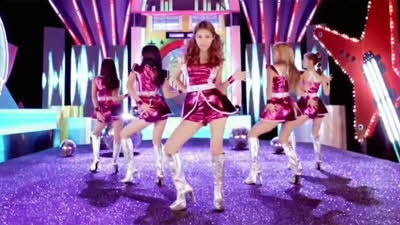
[Video][Website]
[5.67]
Sabina Tang: Kara have been on a hot streak since “Pandora,” maybe even “Step” last year. I’m uncharacteristically in love with how intentionally over-vivid this is, saturated and compressed in keeping with the visual theme — there’s a background noise in the first verse (“shigeki motome kurikaesou”) that is probably meant to evoke a rocket taking off but sounds more like microphone feedback, just this side of painful. The off-kilter build keeps one guessing, and the chorus is pure dance bliss. Still waiting for the producer who’d build an entire pop bass line from that “character selection” noise, though.
[8]
Patrick St. Michel: When “Electric Boy” was first announced as Kara’s next Japanese single, a rumor appeared on Twitter that the song would be produced by Yasutaka Nakata, best known for his work with techno-pop trio Perfume. The song title sounded like something Nakata would come up with, the teaser looked a lot like Perfume’s “Chocolate Disco” video, and the feeling on this side of the world was that J-pop and K-pop would eventually have to collaborate with one another. Expectations for “Electric Boy,” accordingly, were through the roof. Turns out Twitter-born rumors lacking any sources are more often than not false, and “Electric Boy” isn’t produced by Nakata, although its electro-overload sound isn’t too far off from Nakata’s vibe. It doesn’t come anywhere close to Kara’s recent Korean single “Pandora” (THAT CHORUS), but it sounds way more lively than anything they’ve released in Japan since last year’s “Go Go Summer” and still manages to sound more forward-thinking than like 80 percent of contemporary J-pop. (Google “Sexy Zone,” and then destroy your computer.) I’m sure the Kara-Nakata song in my head is better, but this works for me.
[7]
Katherine St Asaph: K-pop pastes a Jessie Malakouti verse onto one of those 2000s crossover dance choruses by artists with names like ATC or IIO. I am fine with this. Shame nobody finished the bridge.
[6]
Brad Shoup: Entirely un-rapped, but it’s not like the singing flourishes as a result. The vocal scale exercises are a failed gimmick; I think I prefer the dance-pop stakes of the chorus to the SFX-charged sass of the verses.
[3]
Will Adams: “Electric Boy” is littered with bad ideas: the chromatic stepping in the pre-chorus, the cheesy lightning bolt FX, the brickwalled electropop that doesn’t let up, and the maudlin breakdown. The chorus could have been the redeemer, but even that derails in its second half when the smooth melody diverts into a playground chant.
[2]
Jonathan Bogart: Twitchy, propulsive, and trebley, with the vocals divided between sugar-sweet melodies and girl-gang chants. If the chorus feels like it’s been run through hundreds of times, the post-chorus “ay-o”s make up for it.
[7]
Anthony Easton: The performative hyper-femininity of Korean pop must mean something. This track, with the woo-oos and the last florid bits of production, suggests its potential for camp.
[8]
Iain Mew: Lightweight to the extreme. The production throws in as many sharp touches as possible within the routine, though, and shuddering electric shocks and the “eh-oh” escalations even break out of it.
[6]
Alfred Soto: Electropop needs more eh-oh-eh-oh refrains. So does this number.
[4]