Weblurbitweblurbitweblurbit
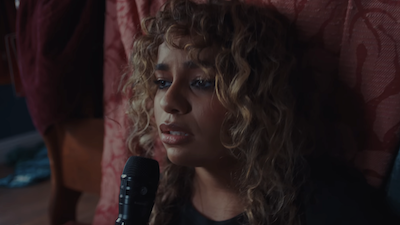
[Video]
[5.57]
[5]
Al Varela: This song is an interesting contrast to last month’s “Die On This Hill.” Bella Kay outright admits to enjoying being used by her partners, as it gives her purpose. A crazy toxic sentiment that would spawn a million red flags for me, but Bella Kay makes no illusion of how fucked up it all is. For her, it’s part of the thrill. Which is at least more honest than Sienna Spiro dying for a relationship she doesn’t even want. Not to mention the production on “Iloveitiloveitiloveit” is substantially better, loose and carefree in a way that sounds romantic in spite of its messiness. Gives me more room to hope for the best for Bella Kay rather than be concerned for her safety. At least she knows what she’s doing.
[9]
Claire Davidson: I’m sorry, but in the current year, it’s very difficult for me to enjoy a song that opens with a young woman singing the line, “I like being used, it means I have a purpose.” Yeah, yeah, I know, it’s obviously tongue-in-cheek, indicative of how bad Bella Kay’s relationship is from the start, but it’s hard to appreciate any sense of irony on her part when “iloveitiloveitiloveit” is so dour. Given the title’s breathless stylization, I thought I was getting a Camila Cabello retread, but instead the song plays like a Noah Kahan reject, a bed of acoustic strumming propped against a backdrop of cumbersome, reverb-swollen guitars. The instrumentation is so incongruous with the song’s subject matter that it might as well be a joke in of itself, a total rejection of the kind of energetic hedonism that would’ve been needed to make this song’s ill-advised hook-up even remotely interesting. Kay doesn’t even bother to describe what about her ex is the least bit compelling, banking on little more than the fleeting currency of relatability to anchor the song’s drama.
[4]
Nortey Dowuona: Idarose, I never even knew about your game, I apologize.
[8]
Leah Isobel: I generally understand pop music as a space for fantasy and projection rather than as a strict depiction of cultural values. Like, what I got out of Britney Spears songs as a kid was not a literal example to follow, but a gateway into some broader understanding of femininity — how women are perceived, how women work within and against that perception, the options available to us, the kind of strength needed to live inside that system. That playacting space can be really vital. And yet, pop music is also product; it’s a creative expression and also a piece of merchandise designed to sell, generated by an industry built around making art into profit. Sometimes, if a song feels grand or interesting or vital enough, I can let myself forget that. But sometimes, if the song is “Iloveitiloveitiloveit,” it’s all I can see. American culture is the most openly misogynistic and puritanical it’s been in years; women are supposed to be quiet and grateful for attention, perfect objects, perfect mothers, perfect toys. This is supposed to be natural. In pop, an acoustic guitar reads as natural and authentic; sparseness is truth. So this rendering of a narrative in which Bella loves a guy for being mean to her — using her (her words!) — naturalizes it, makes it relatable, makes the sexiness she’s performing more reachable for a listener, and also lays bare the violence beneath it. The violence and the sexuality are intertwined. I guess bringing morality to a pop song is a stupid game. And yet I hear this and I’m like… if I was 16, and I was dating a 23 year old who made me feel bad about myself — or if I was 18, and I was dating a [redacted] year old who made me feel even worse about myself — what would I take away? Is it comfort, or is it resignation? What should a woman feel and do about a man who hurts her? What is the limit to our imagination?
[1]
Jacob Sujin Kuppermann: An imperfect provocation — the first line is a little going door-to-door to shock people for my tastes — but an effective one nonetheless; Kay throws a lot of swings and most of them connect. There’s not much new here: “let’s let fate decide/heads we go to yours/tails we go to mine” is a Miranda Lambert hook, “we don’t have to get into what that says about me” is Olivia Rodrigo. And yet Kay puts these cobbled together pieces of cynical love songcraft together into something inspired, a compellingly spare arrangement propelling her to interestingly desperate places. I could see this becoming an alt rock standard of some sort; at very least, Richard Thompson could’ve done a great cover of it in 2005.
[8]
Ian Mathers: “We don’t have to get into what that says about me,” ok, but also as everyone from Springsteen to Sally Field can tell you, eventually you are going to need to unpack that shit. And I can tell you firsthand that when you do you get to wince a little extra for every time you’re flippant about it while making the kind of self-destructive decision we’re talking about here. The song is just kinda there, but I hope it gets her the money and resources we all deserve to have to deal with it.
[4]