Giving the ol’ Reader Poll a workout…
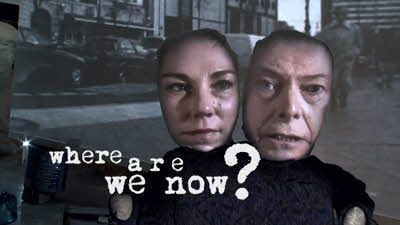
[Video][Website]
[5.42]
Alfred Soto: Bowie’s disappearance was among his canniest moves and without a doubt his most memorable gesture since wearing flip-flops on a 1999 album sleeve. I didn’t want him back. Better to live, like Saul Bellow, as a set of greying profiles in Manhattan cool. If I considered his return, I didn’t dread him recording a chillwave record: I knew he’d record a dreary autumnal ballad instead. Well, here he is, mumbling German names over singer-songwriter-sensitive piano. Letting my imagination linger on the image of Bowie writing about doing homework with his daughter embarrassed me, but this tentative nod to survivorhood is all so unnecessary.
[6]
Jer Fairall: In which the classic rock titan least likely to go the Sentimental Old Fool route does exactly that, with all the drippiness of a Rod Stewart covers record and the same set of hoary vocal moans and sighs that Paul McCartney displayed on the album that he at least had the good sense to call Kisses on the Bottom, thus preventing us from ever taking it as seriously as Bowie demands we take this.
[3]
Anthony Easton: One of the genius things about ’70s Bowie is how important boredom was an aesthetic strategy, or if not boredom then some kind of aesthetic blankness: this bored and frustrated ennui-driven, kabuki-faced formalism in the mouth of this smart, young man, especially after the smug, mugging Beatles and the rich boys gone slumming of the Stones. Though he was interesting and interested onwards from the ’70s — never slipping into sentiment, reunion tours, toxic nostalgia, feelings for the sake of feelings, religious tourism, or messianic pap — he always had the distance about him. He has never disappointed. With the early mention of Potsdamer Platz, all of this collapses. It is nostalgic for his best work, it’s not novel, it doesn’t care what the kids are doing (imagine Bowie working with James Murphy, Jake Shears, Annie, Robyn, DJ Shadow, Big Freedia, Kelis, or Owen Pallett like he worked with Trent Reznor or Goldie in the ’90s) — it sounds old, tired, and sad. I thought he would never grow up.
[4]
Ian Mathers: Some of us liked “Thursday’s Child,” okay? Rewriting that song to be less maudlin and also a Berlin-era B-side only helps. I also like the way his voice sounds now; maybe not as powerful an instrument as it used to be, but the hint of a sob is very effective, especially on “the moment you know you know you know.” That line is probably going to get some casual hate, but there’s something to it: not a bad stand-in for the song as a whole. I was tempted to add a point for all the people the new album art is pissing off, but really I like this enough on its own merits.
[8]
Doug Robertson: The key to reviewing a new song by a “legendary” artist is to consider whether anyone would actually care about the track if it had been released by some other random instead. This, while being a perfectly acceptable concoction of laid-back languidity, would struggle to stand out if it wasn’t for the long tail of past performance tripping up all those who come across it. Bowie seems to accept this, and the sense of nostalgic yearning that permeates the track demonstrates a man who is aware that his best years are behind him but isn’t quite ready to give in to a life of irrelevance just yet. It’s clearly intended to be judged within the context of his backstory, and in that respect it works, but if we judge it solely in the harsh light of the present day it’s a struggle to see it as any more than a mildly interesting novelty.
[4]
Jonathan Bradley: Like Elvis Costello and Lou Reed, those other iconically white male songwriters of the ’70s, had done variously before him, Bowie has grown old by becoming tasteful. (The operative definition of “tasteful” being “slightly-sozzled and alone at a bar.”) “Where are We Now?” is pretty, with its ponderous piano and silvery strings, and Bowie lovingly cradles each word before letting it escape from his lips in that sort of way singers who have uttered thousands similar do, but there’s nothing really to this song. It’s exercise, without effort or purpose.
[4]
Katherine St Asaph: The chord progression’s as crackled as his voice is by now; it’s good that they’re striking, because something’s got to distract from this being only maybe half a ballad.
[5]
Daniel Montesinos-Donaghy: It rumbles, swoons, soothes, feels like the twilight approaching – Bowie repeatedly sings the title as though he has all the answers but is too low to allow them to be shared. He knows and it aches, so instead he hazily recovers loved memories as if the world will crash before these words leave his lips: “as long as there’s me/ as long as there’s you.”
[7]
Edward Okulicz: Denying the diva he always will be, Bowie wimps out of the big end-of-the-first-act torch song this naturally should have become about 90 seconds in. Ah, but that might have betrayed a little sense of humour about mortality, and that’s for younger selves.
[3]
Brad Shoup: If Fucking Scott Walker thinks too much time has passed since your last project, you know you’d best kick out the jams. Does Bowie look upon Walker and wonder what might be? Scott had the better beginning, Bowie the middle, and isn’t it more fun to box a carcass than box your face to garner attention? And while Scotty always sounds like Scotty, no matter how outré the sonics, this single suggests Dexys backing David Byrne: a baleful torch song about kicking ’round the old stomping ground, always crashing the same car into Moss Garden or whatever.
[5]
Iain Mew: The attention given to this surprise return was enough to get a long-standing UK chart rule overturned, which seems faintly absurd for a song so unassuming and small. It’s not so slight as to collapse under the weight of expectation, though, and the title phrase’s soft elegy and peals of guitar at the end are worth the wait both in the song and in the meta sense.
[7]
Sabina Tang: The third acts of rock’n’roll are, to me, more compelling than the first. Not by virtue of nostalgia (not that old yet), but because young, ambitious, tight-knit bands and artists at the start of their careers strike me rather as happy families struck Tolstoy. I know what it’s like to struggle; even to succeed. What I want to find out is what it feels like to succeed beyond one’s wildest dreams and — no, not to fuck it all up; to keep going. To reunite with the guys after 20 years and realize that you fell out because you were dumb kids who spent too long in enclosed spaces with each other; to cut a dance record with hurdy-gurdy and bongos and Tibetan throat singers because you no longer have the same taste as what made you famous; to fight long and hard to define yourself in the public’s eye and your own, then discover you want to blow it up and start again. And again. And again. David Bowie, here, breaks a decade of silence in order to present what seems to me the most realistic “good ending” one could manage to a story like his. Alone in a city that you realize you still love; anonymous as long as you keep walking; melancholy and unbearably grateful for every ghost. Is “Where Are We Now?” essential listening after the 2002 recording of “Conversation Piece” (which, unsurprisingly, I far prefer to the 1969 original)? Not really. Does it have a degree of understanding to impart? I feel so.
[9]