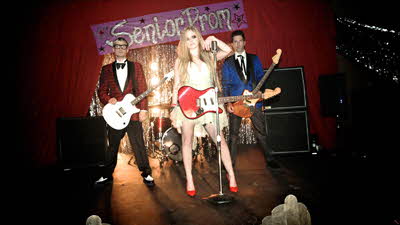
A clever caption should go here, but all I’ve got is “are those Jessie and the Toy Boys?”
[Video][Website]
[4.67]
Isabel Cole: Avril exists outside of time. By which I mean, primarily, have you seen her face, but also that hers is an artistic persona admirably resistant to change. She’s still and always smudged eyeliner and a stuck-out tongue, taking bratty platitudes to escalating heights of unmeaning. “I’m like, yeah, whatever, we’re still living like that”: what a gorgeous monument to vapidity, steeped in the vagueness of a shifty adolescent meeting her friends at “the spot.” What spot? The spot, you know, in the place. What place? The place with like, the stuff. What stuff? Who else is going to be there? I need to know these things, Avril. Like, people, I dunno, we’re still figuring it out, why you gotta make things so complicated, Mom? Later she’ll have a bottle of whatever, but it’s getting us drunk, the kind of bottle you pass immediately to newcomers who take a swig without asking what’s in it because it’s all the same in those early stages when alcohol is purely functional and getting drunk is secondary to signifying that you’re drinking, you’re a person who drinks, I’m so trashed right now you guys!!! Or maybe I’m wrong. They’re dancing in bars; maybe this is, improbably, scene and not memory, even though there is the word “boombox.” Maybe the fuzziness is the kind that comes after too much beer or vodka or whiskey or whatever, it stopped mattering after the first couple or several, the kind that belongs to nights where you find yourself in one place, then another, with no recollection of the journey between. We’re running down the street, we’re raising our cups. We’re singing Radiohead at the top of our lungs. I hate Radiohead and I’m so happy about this. I don’t remember this bar having a jukebox, I don’t remember getting to this bar, I don’t remember where I am, I’m so trashed you guys, no but really, is there a bathroom. Or a trash can. I’m in the bathroom, when did that happen. I’m in my mid-twenties, when did that happen. Avril is 28, when did that happen — j/k j/k Avril doesn’t do age. I’ve set up a false dichotomy here. Drunks and teenagers alike careen with disoriented giddiness through the eternal present where Avril Lavigne actually lives. If I heard this in a pizza place I’d spend half a verse convinced it was “Complicated” and feel sudden tender kinship with my fifteen-year-old self hearing “Complicated” out of the tinny speakers of half a dozen pizza places up and down the city, and this union with the past is Avril’s default state of being. I’m so jealous of her. A body immune to decay never gets hangovers.
[8]
Scott Mildenhall: Proof after over ten years that things can be uncomplicated, the trick being to simply make them “Complicated”. It’s all just heavy signifying. It sounds like a song she did a decade ago! It’s about never growing up! Do! You! See! The only noticeable difference is that her voice, never actively pleasurable to listen to, sounds even less human than it did on the first verse of the original.
[5]
Jer Fairall: Her obsession with reclaiming her youth seemingly beginning the second she physically outgrew her sk8er girl phase, Avril’s post-teenage output lacks the poignancy that it might have gained were there any evidence of youth being lost in the first place. There’s a sweet ache to the “say, won’t you stay forever / we can stay forever young” bridge that suggests that she might actually be getting better at supplying the kind of pathos that this would need to sound like something greater than the pop song equivalent of Matthew McConaughey in Dazed and Confused, but she remains incapable of projecting anything other than petulance on her fast songs.
[4]
Alfred Soto: The title sentiment disgusts me. Most of our problems stem from a fetishizing of the supposed ineffability of youth – we need more grownups, fewer Radiohead fans. But for Lavigne “forever young” means preserving what impressed us ten years ago: Gary Glitter chants, acoustic riffage, stretching vowels like moist Juicy Fruit. She still sounds pretty good; I’m ten years older.
[6]
Anthony Easton: If you have a kid and a business to run, and aren’t 18 anymore, maybe growing up is not a bad thing.
[2]
Patrick St. Michel: Maybe some day in the future, Nickelback will call up Max Martin and go full-blown pop. Until that day, here’s the closest the world will get to such a single, except with a singer people don’t loathe and the most baffling use of Radiohead in a song ever.
[3]
Daniel Montesinos-Donaghy: There is a snippet in Simon Reynolds’ recent Spring Breakers essay for Sight & Sound magazine in which recent US chart music is assessed for its drink-and-drug-happy wildchild wave, something that he says feeds into Harmony Korine’s film. He uses Katy Perry’s “Last Friday Night” as an example of how potentially transgressive attitudes are placed into pop megahits, writing that her references to skinny-dipping and ménages glide over despite what he perceives as her blandness; I’d go one further and say they lack salaciousness because of her blandness. Avril Lavigne’s “Here’s To Never Growing Up” goes one further by expressing a happily wild lifestyle with friends and muffling it under mid-tempo guitar strums and lame self-censoring (pointedly dropping the word “ass” – as in “kiss my…” – is just embarrassing). If you’re going to get drunk and stand on top of the bar, you shouldn’t sound like you’re reciting shopping lists over a building society’s “on hold” music and you shouldn’t save your energy for a self-satisfied cackle at the end of the song: fun and danger should walk hand in hand, as Ke$ha’s entire career has shown us. Or at least alluded to, as Taylor Swift’s recent “22” did. But Lavigne has thrown all the pretend riotousness in your face whilst crafting something completely harmless, disregarding the spirit of the song even as she performs it. She blands out the good times.
[1]
Iain Mew: I wonder if the degree to which the verses sound like “Complicated” is a meta commentary on not growing up. If I hadn’t moved on in ten years I would still be posting message board screeds about how annoying Avril is and how awful it is that she pretends to be rock but clearly isn’t. I would kind of like to see my reaction at that point if she’d started singing about singing Radiohead at the top of her lungs. She has moved on of course, and the chorus is a progression, if not necessarily in the right direction. It has brute force catchiness on its side, but sits awkwardly in the song and she’s regularly achieved the same sentiment better in the past more indirectly. She didn’t need to make it any more obvious.
[5]
Brad Shoup: Staying young can be an easy proposition if you put your mind to it, unless you’re a pop star. Lavigne spikes her formula with some shouty bros (shades of “Young, Wild & Free”) and Ke$hian inflection/drum programming on the chorus. But the sentiment comes at the tail end of a thematic pop cycle. At a certain point, willing youth is a symptom that it’s passing; before, you were content to embody it. That those shouty bros end up sounding like a Brad Paisley touch could mean that musical middle age has set in.
[5]
Crystal Leww: We’ve actually had the opportunity to watch Avril Lavigne grow up over the last ten years or so, and unfortunately, this sounds nothing like the Avril of “Complicated” or “Sk8er Boi”. This sounds kind of tired and sad.
[4]
Will Adams: Let Go is a classic because it’s so believable. Avril Lavigne the character couldn’t be clearer on that record, her arms-crossed scowl on the cover reflected perfectly across the hometown raps and punk posturing. Given that, it’s understandable that “Here’s to Never Growing Up” yearns for youth, but it’s so ungainly about it. The lurching tempo and canned crowd cheers are bad, but I’m most concerned for Avril herself. She sounds strangely robotic, an Auto-Tune gauze smothering her vocals. She can barely muster up any enthusiasm for the bridge, as if she’s not even convinced that there’s any hope to recapture youth. A charitable reading would posit this song as a response to pop’s recent affliction with Peter Pan syndrome, but the buried laughter at the final chorus tells me that she’s really trying to go for it.
[3]
Katherine St Asaph: Between the showoffy Radiohead namedrop (which song?), the drunken chorus of suspiciously robust dudes and the potential wedding tie-in, I was convinced Chad Kroeger lent Avril a track. Sure enough, he did! And now everything about this makes sense! Whether “here’s to never not being Nickelback” is a more appealing concept for a song than “here’s to never losing the youth demo” is debatable, but I think it’s clear who’s the more appealing vocalist.
[4]
Edward Okulicz: I’m not sure if it’s the shuffly backing or her vowels that are more stilted — even when this pose worked (see “Complicated”), she had a rhythm she could strike a pose to, which she doesn’t here. Avril is legitimately a trailblazer for a whole lineage of modern pop, but some of those avenues belong to others, specifically Ke$ha. This aims for the same territory as “Die Young” but is written and sung with the weariness of someone who has grown up. Just the fact that I remember when Radiohead songs were good sing-a-longs makes me feel about 100 years old. The pre-chorus is a few seconds of joy, but she can have all the swears she wants, but I don’t smell the snot like I still can on “Complicated” or “He Wasn’t” or “Girlfriend.”
[5]
Jonathan Bogart: Like “We Are Never Getting Back Together,” it’s a march tempo where the lyrics and air of celebration suggest it should be a dance tempo. But the statelier rhythm gave Taylor the space she needed to sharpen her claws; Avril just sounds like she was aiming for Ke$ha and fell short. The acoustic guitars suggest that the Radiohead song she’s singing is either “High and Dry” or “Fake Plastic Trees,” which are only fun to sing along with if you can screech as well as Thom Yorke. She can.
[6]
Jonathan Bradley: Once upon a time, while sitting in a dull high school assembly, a friend and I entertained one another by making a packet of chips dance as we imitated the horn riff from Radiohead’s “The National Anthem.” I mention this because, even if Radiohead songs aren’t exactly the stuff of sing-alongs, any music someone feels enthusiastically enough about can become the stuff of social experience. And yet Avril’s Radiohead reference on “Here’s to Never Growing Up” feels incongruous because Yorke’s band has become the quintessential example of self-consciously cerebral music specifically designed not to be shared. One listens to Radiohead seriously and in seclusion; one does not share or exult in the communal experience of Radiohead, and so Avril’s elated chorus about getting drunk and hollering along to “Packt Like Sardines in a Crushd Tin Box” or whatever suggests that maybe she Just Doesn’t Get It. But meeting people is easy, y’know, and when Radiohead escapes the studio, people use this very popular band in the same way they use the music of loads of other popular bands: to form connections, to express shared joy, to celebrate and sing along to. Avril is about a year younger than I am, and Radiohead is in its own way as adolescent as Avril has so determinedly been throughout her career, which makes this hook a double felicitous absurdity. More than anything else though, “Never Growing Up” sounds much older — as distinct from more mature — than anything Lavigne’s done before; compared to the immediacy of the joie de vivre in Taylor Swift’s thematically identical “22,” this tune sounds like its youthful clamor is transitory — and all the more precious for it.
[9]