“Regarding the lyrical composition, Pharrell stated that the song is not just about a sexual conquest, but the fortune in finding potential chemistry with someone.” –Wikipedia
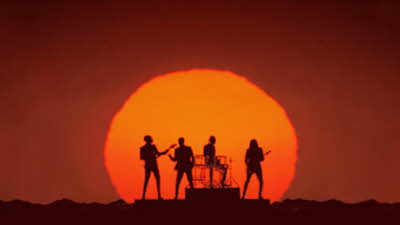
[Video][Website]
[6.82]
Edward Okulicz: This is perfectly pleasant, in the way that any of the old, expansive disco records that got electrified and turned into 2000-era dance monsters are pleasant, in the way that “Cola Bottle Baby” is a fun track, but when stuff was added to it, it was really fun. What I mean is, this sounds like the “before” in the process in which Daft Punk might have taken something with potential and made it transcendent, not the “after,” which is what it has to compete with on the charts and in our hearts. It sounds like an okay Nile Rogers track. Pharrell’s singing is okay. The vocoder bit is there because it has to be, and it, too, is just okay. There’s nothing transformative about this meeting of the minds, they all do their things, but the combination isn’t magic or more than the sum of its parts; it’s merely a pleasant 2am cruise around the suburbs at 25 miles an hour.
[5]
Alfred Soto: Even on Kendrick Lamar’s “good kid” Pharrell sounded thin. How and why he became a signifier of soul in the early 2000s mystifies me; he manufactures a feeling. It works here because the damn track is hologram disco anyway. Thank Nile Rodgers, whose chik-a-chik-chik has supported everyone from Simon Le Bon to Grace Jones, from blank to frank. As for the name above the credits, it knows from holograms.
[7]
Will Adams: Part infinity in the series Will Adams Not Getting Daft Punk.
[5]
Patrick St. Michel: I’ve spent all week turning around ideas in regards to this song, but ultimately simplicity won out. Daft Punk haven’t lost their ability to create incredibly catchy music, and Nile Rodgers’ guitar contributions are disco pomp crystalized. But I just really don’t like Pharrell’s vocal, which monopolizes the song. I…sorta just want to hear Daft Punk make vocoder magic.
[6]
Anthony Easton: Pharrell Williams has done some serious work this year. His writing here is just this elegant shimmer of cheap gold lamé and silver foil. As beautiful as it is disposable.
[8]
Crystal Leww: The song is about getting lucky, but it’s not really makeout music so much as twirl-your-boo-and-corny-grin-in-the-club music.
[6]
Jonathan Bogart: I’ve been spending a lot of time with original-recipe disco for reasons of my own, and only Pharrell’s relatively relaxed singing and the clipped edge to the robo-voice keeps this out of the 1977 hall of fame.
[9]
Brad Shoup: If you’re seeking the hammock hang of a funk rhythm guitar, you’re in luck. If you want something for the proles… wait for the album, I guess. This is perfectly calibrated for the friends-of-friends party blues, with the glorious throwback bit saved for the end when you just need one thing to focus on. Get wistful to the filter funk, then get gone.
[5]
Sabina Tang: Daft Punk and Nile Rodgers are key contributors to GPH (gross planetary happiness). The warmly goofy lyrics feel more Lindstrømian-terrestrial than interstellar, though the undeniable hands-up moment remains 2:20 in, when those robotic cut-up voices (finally!) enter on the breakdown. Hardly matches the architectural ecstasy of “One More Time” — Pharrell is set on maintaining the groove rather than sparking off fireworks — but this radio edit’s lack of beginning or end only makes it easier to Infinite Jukebox. One point withheld for the proper club cut, which will surely make more of that zigzagging synth outro melody.
[9]
Katherine St Asaph: Allow me to restate: Nile Rodgers, featuring Daft Punk, Daft Punk’s sequencer lines and passable Pharrell. If the second half sounds acres better than the first, there’s your answer. (Well, unless you’re listening to a looped leak. Did those ever even happen?)
[7]
Daniel Montesinos-Donaghy: As TSJ’s resident Neptunes stan, I shall refer to a passage from Pharrell Williams’ Places and Spaces I’ve Been where he discusses the effect that seeing the Jacksons’ “Shake Your Body” on television as a child: “Why was [Michael Jackson] so different in that two-dimensional world? Was he just different?” Williams has always presented himself as proudly individualistic and while this has (rightly) made him iconic, he has never seemed able to approach the effortless poise of his own icons — his music is too busy, a zone where all his fascinations simultaneously jostle for attention, where ideas are stacked on top of ideas. (Revisit this years’ “Nuclear” and “Blurred Lines”: both deceptively simple, both plump with Williams’ idiosyncrasies and musical diversions.) On Daft Punk’s “Get Lucky”, the weight of composing is lifted off of his shoulders and the clutter — great though it is! — vanishes, culminating in one of Williams’ best vocal performances. It is certainly his most poised, his most effortless, hell, his most Michael. His hosts don’t strain themselves musically, more a show of assurance than strained simplicity. As far back as Thomas Bangalter’s “Club Soda” from 1998, they pounded away at disco licks within the strains of house. One can understand them favoring a warmer sound, something more carefree, gleeful even. You would forget from their robot costumes or the Internet’s collective idol-worship streak that they are human, after all.
[8]