Political statement or referendum on twee?
[Video][Website]
[5.00]
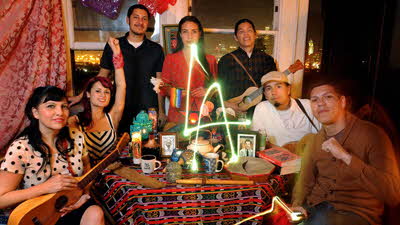
Tara Hillegeist: In the best folk music, love and politics are equal mates: equally fierce, equally tender, equally arresting. In Las Cafeteras’ case, the “arresting” part also includes the occasional consequences of their active involvement in Chican@ social justice protests in and around Los Angeles, which makes the chorus of “won’t you walk with me, Luna, through the park” strike at an even deeper subtext of compassion, something the song’s joyous queerness only further amplifies; I cannot be the only one who sees something of a The Dreamers-style threesome in the lead singers’ mutual and harmonizing courtship of Luna. Nor can there be any more cogent personal/political mashup, given the collective’s plainly stated activist desires, than “walk me through your land” as a romantic plea. Colonization violently compromises bodies and borders alike, and in reclaiming either you sow the seeds of a needed revolution; such revolutionary romances can grow a love that’s beautiful and kind and uncompromised and true. Las Cafeteras demand that love like they have always demanded freedom, and make it unavoidably obvious that the two needs are one and the same. To refuse that would be — well — criminal?
[8]
Iain Mew: “I traveled so far across the land.” By the end it definitely feels like it, though the journey’s picturesque.
[6]
Jer Fairall: The intricacy of the playing is skillful enough to temporarily draw my attention away from the new Laura Marling record, and the lead female vocal is so pretty in its uneasy fragility that I’d be willing to follow it just about anywhere, but folk music cannot help but be at least somewhat about the lyrics, and these are unavoidably trite.
[6]
Anthony Easton: Although the band is from L.A. and Chicano, and seems genuinely interested in the political problems of language/translation, neither fact explains lines like “won’t you take my hand/let me understand” or “hope this night will never end/maybe you and I can be friends.”
[5]
Katherine St Asaph: How are they from L.A. and not Berkeley?
[4]
Brad Shoup: It’s my biennial Hope For Agoldensummer mention. Twinkling, lilting: the affectless voices (female and male!) atone for a world of twee misdeeds. Please, though: tell me we’ve hit our ukulele quota for 2013?
[6]
Alfred Soto: I expect ukelele sincerity from Train or Zooey Deschanel, not from an act with a cool Wiki. Three minutes too long, tuneless, and cornball until the male harmonies intervene.
[2]
Daniel Montesinos-Donaghy: I’ve listened to this song seven times in a row and cannot remember anything about it for the life of me.
[3]