All we need is a Don Henley duet.
[Video][Website]
[6.22]
Anthony Easton: The elegant sang froid has melted, and the references are more modern. The geographical shift in order to get over someone has been plaid forever, but this is haunted with the failure of the strategy. I am never quite sure who she is singing though–and that line about Saigon, historize this, maybe as much as the girl group choruses of “move, baby”. But those swoons might as well be auto-tuned to death. Listening to this for a couple of weeks, I am stymied. Until, I finally figure it out. I have a thesis, is this song about the history of Cher? From her girl group routes, to her California failures, from the movie career, and the return with Believe. I think this might actually be an extended allegory with Cher as goddess of the West Coast?
[8]
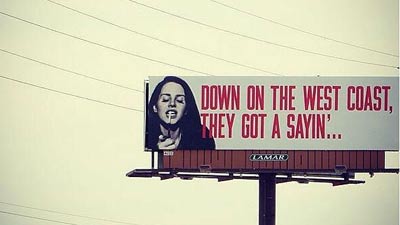
Alfred Soto: “Down on the West Coast they got a saying,” she sings in a high quavery voice like Tori Amos’. The melody-poor chorus consists of mysterioso purring. I suppose she gets points for inverting listener expectations about the West Coast sound. Are Russ Kunkel and Waddy Wachtel retired?
[5]
Daniel Montesinos-Donaghy: My sister and I have a long-running in-joke about Lana Del Rey’s narcotised music, the type of silly lyric-changing that makes us turn “Video Games” into a song about staring at a KitchenAid for hours while on a cocktail of undefined “blue pills”. Yeah, that’s a mean joke. Del Rey’s career has been fodder for about a thousand of them, and “West Coast” looks to continue that trend by being so very self-consciously Lizzie. It’s a series of hazily-mumbled lyrics depicting the romantic and tragic, sonic signifiers of a devilish Californian allure (best of all, the Zapp-esque synthesiser at the end), a focus on a wavering vibe rather than thorough songwriting. It’s music to luxuriate in, but never too deep. My sister and I probably won’t stop our mean jokes, which means we understand that the wheels haven’t fallen off this enterprise yet. Lana keeps doing Lana, pretty much.
[6]
Katherine St Asaph: In which it turns out damn Dan Auerbach is singlehandedly more effective at evoking L.A. noir than any of Lana’s vocal lurches to date. Docked a point because even The Mask is more believably Cuban than whatever Lana thinks she’s doing.
[6]
Megan Harrington: Everyone’s selling you something, and Lana’s no different. Here it’s a dangerous fantasy of California, riddled with every trope from manifest destiny to Mexico. She plays the escapist, peddling backwards stereotypes, inviting the audience to participate in a massive regression. But right as you’re about to consent, the danger becomes Lana herself. He’s on the balcony, he’s swaying and Lana insists, “move baby, move.” So often she’s mistaken for pure surface, a beautiful face to project your fantasies onto — “West Coast” is nothing if not an utter refutation of that concept.
[9]
Scott Mildenhall: Where’s the chorus? There’s a moderately expensive-looking trailer for EastEnders at the moment that features “Gods And Monsters”. It creates the right atmosphere, and a minute is enough to get that and the “innocence lost” message over. This has an atmosphere too, but four minutes is more than enough for it to get very tiring. Even pretending it’s about Blackpool doesn’t really entertain.
[5]
Brad Shoup: It’s a mini-suite of pastiche, like some ambitious AOR cut from the mid-80s. When she shudders to a halt, the band brakes with her — there’s a live feel to this, perhaps some barely-lit hideyhole where the tape manipulator can shine in secret. Since I’m pretty sure this won’t blanket pop radio, I’m feeling kind toward it.
[7]
Rebecca A. Gowns: Your aunt is drunk at your wedding. She asks if she could speak to you for a moment, and drags you away from your new husband. It’s in the lull between dances, and she takes you to a corner near the DJ; a Beach House song is blaring a little too loudly from the speaker next to you. Your aunt leans in, and you think you’re going to hear something sweet. She slurs: “Down on the west coast they got a sayin, if you’re not drinkin then you’re not playin. But you got the music, you’ve got the music in you, don’t you?” Your smile freezes as you realize she thinks she’s giving you a deep insight. Her eyes are glazed over as she whispers to you about her baby on the balcony smoking a Parliament. “He’s crazy y Cubano como yo my love.” The Beach House song swells even louder. You are caught between a rock and a hard place; the too-forced lush instrumental in one ear vs. your aunt singing something that sounds like a Fleetwood Mac refrain in the other. She reeks of gin and cigarettes. You can’t wait for the moment to be over. It is, truly, the worst. But something in her urgency keeps you rooted. In fact, you may remember it for years afterward: how awful, how desperate, how sad.
[3]
Will Adams: It’s not surprising that Lana’s voice is just as well suited to hazy noir as it was to the expensive production of Born to Die. “West Coast” lumbers along at a familiar clip for her, but in a genius move, the chorus dials down the tempo even more, turning it into its own slow dance. I can’t quite make out what she’s saying, but I like what I hear.
[7]