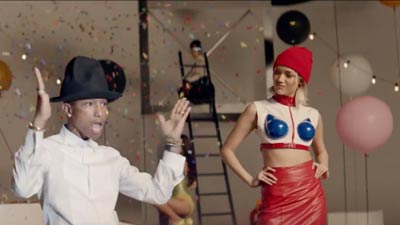
We could’ve screencapped any number of girls, but today you get Leather Poliwag Bra…
[Video][Website]
[5.69]
Patrick St. Michel: He had to follow up “Happy” with something, and this was probably his best bet. “Marilyn Monroe” sounds rushed, the lyrics particularly a drag — a list of famous women, followed by the word “girl” repeated a dozen times. But then again, his inescapable hit is mostly repetition too, and “a room without a roof” is still sorta clunky. Yet “Happy” laid claim to a dizzying structure that captured the titular emotion perfectly, practically making words an afterthought. This isn’t quite as captivating, though to Pharrell’s credit the strings make this far more dramatic than it should be, and the way he threads his words along sounds pleasant enough.
[6]
Stephen Thomas Erlewine: Pharrell returns to Michael Jackson mode for a purported ode to Hollywood icon Marilyn Monroe, an aesthetic decision that theoretically makes sense even if the single never feels indebted to Marilyn or anything that flickered across the silver screen. Marilyn is never present here (nor is Joan Of Arc), but that never really matters; it’s about feel and sometimes the hook, both of which are appealing but never ebullient.
[5]
David Sheffieck: It’s perversely fascinating, seeing Pharrell become a human Upworthy.
[7]
Anthony Easton: The strings that open this are so sumptuous, they come close to Johnny Mercer territory, a place I didn’t think could be reclaimed. The rest is Pharrell running out of juice a bit, though it is a pleasure to hear him reaching into full falsetto. But Monroe had scandal, and Joan of Arc had faith. This has neither.
[3]
Katherine St Asaph: Hans Zimmer conjures up a fantasia, like this shouldn’t be a Pharrell song but a movie screen with someone’s exquisite spotlit face; but it’s got a whiff of kitsch, of drugstore makeup used to 1940s ends. (In the sorting of violinist Ann Marie Calhoun’s myriad credits, this is less 2012 Oscars, more 2011 Incubus.) It’s The 20/20 Experience trick again, then: strings that don’t signify emotion but strategic grandeur, purchased to brand and elevate a tiny, tinny thing that’s nothing but a vessel for Pharrell’s Deepak Chopra macking and album title drops (and Kelly Osbourne, I guess?) Functional and perfunctory.
[5]
Brad Shoup: As usual, a solo Pharrell single sounds like a guide demo. It’s like he took a grandiose opener and stripped the fixtures. The chickenscratch riff and plucked violin motif hang around for a bit; he sings the album’s title until a bad rhyme or sexy aside occurs to him.
[5]
Megan Harrington: I think this might be an alright song, but Pharrell is just about the worst singer going.
[4]
Will Adams: The nerve of this man to keep singing on all these excellent pop songs instead of handing them to more capable vocalists. “Marilyn Monroe” is no exception; what a waste of Ann Marie Calhoun’s gorgeous string arrangement.
[5]
Thomas Inskeep: I love Hans Zimmer’s orchestration on this; his bromance with Pharrell, unlikely as it seems, brings me joy. I also love Pharrell’s vocal and don’t get people who claim his voice as not-very-good — to my ears it’s deliciously supple, and his falsetto is so damned pretty.
[6]
Daniel Montesinos-Donaghy: For someone who once gave Snoop a click-clack mouth-pop bassline, Mr Williams is an underrated tics man. On “Marilyn Monroe”, he’s working overtime on the little details. Listen to the bridge before the second chorus — he’s a sighing, jaw-jutting, slyly laughing, whispering, panting, dramatically swooning instrument. Williams’ voice has improved tenfold since his squeaky Curtis Mayfield impressions, but his vocal performances are underestimated by those blind to the extra work he does. The tics don’t make “Marilyn Monroe” great — this daydreaming glitterball suite of a song is brilliant without them — but they give it an extra burst of colour, character and curiosity.
[9]
Alfred Soto: The strings and percussion set up an air of combustibility; anything is possible, especially when it hints of “Papa Don’t Preach.” He works up a sweat, as he must, because his metaphor is crap.
[5]
Mallory O’Donnell: Musically, this is a self-assured, accomplished piece of art-pop. All of Pharrell’s instrumental virtues — space, bounce, timing — are applied to a progressive disco mini-suite that doesn’t mistake adding layers for adding ideas. Where the questions arise is with the lyrics. Does he want a different girl or a “different” girl? In his defense, the artist submits three rather obvious but inarguably dissimilar examples of womanhood and claims to want nothing to do with them. Whether we see this as a manifestation of the lover’s credo or chauvinism extended into historical space depends on how closely we read said lyrics.
[8]
Scott Mildenhall: “I promise not to abuse you”? Cheers Pharrell, you’re a real catch. The lyrics are mostly hokum — if you really don’t need adjectives, then dropping in one as feeble as “different” only serves to undermine rather than underline your point — but there’s enough genuinely interesting stuff going on elsewhere for this to be somewhere near as good as it aspires to be. Morse code guitar, tiptoeing strings and foghorns evoke some kind of lighthouse-based espionage: likely not the intention, but it should have been.
[6]