Our original plan was to present each blurb and score as a string of hexidecimal characters…
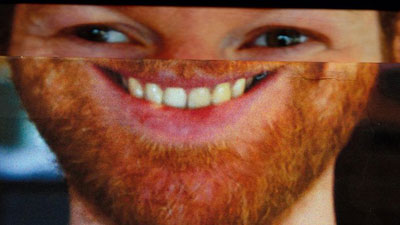
[Video][Website]
[6.25]
Alfred Soto: This is nice. With his reputation swollen by twenty years of excellent press and a generation’s having passed Selected Ambient 85-92 along like an heirloom, Richard D. James was due to release nice music. His shrewd use of an acid house bass line and a Four Tet-esque vocal pushes, ahem, the right buttons. Perhaps modest expectations were best after all.
[6]
Thomas Inskeep: It’s certainly a more traditional “pop” song than most of his catalog, which is not how I expected Richard D. James to come back under his most well-known guise. As someone who was a big e.e. cummings fan in college, I love the way he titled this, and I love the album artwork as well (Designers Republic, of course). But what of the song? “minipops 67” is actually pretty techno. Not shocking, exactly, but still a bit of a curveball as far as the Aphex Twin comeback goes: fluid and movement-y like the best Underworld tracks. Unexpectedly lovely.
[7]
Tara Hillegeist: A fun, blurbing bit of poptronica more notable for who released it than for its quality; which is not a slight against the track at all, as it’s absurdly hummable. Like many a kid who came to Aphex Twin by way of the video marketing for the Windowlicker and Come to Daddy EPs and hasn’t listened to his work in close to half a decade, I’m always surprised by how easy beauty and joy come out of his equipment, even despite whole hours of music proving that’s what he does best. Nothing wrong with a new Aphex Twin track making me smile like a new Underworld track would, yeah?
[7]
Cédric Le Merrer: So here we have a guy who made futuristic music in a time when the future was something betwen the Lawnmower Man and The Matrix. The mere fact that this track (which is apparently 7 years old) does not sound as terribly dated as all this now that we live in the future is probably the most welcome compliment you could make to a guy like Richard James. Of course it does remind one of some long-past time when to access his soundscapes you’d have had to at least burn a copy of a friends’ CD, but this wouldn’t feel out of place as the soundtrack to something about glassholes or whatever. Had it come out seven years ago though, we’d probably be less ready to be dazzled by all these copypasted bits and pieces that start and stop and restart in barely half expected ways to form just enough of a beat to call this a song. So I’m a bit impressed because no one does it better than Aphex Twin. But as impressed as I am, I can’t really get past the fact that all of this builds up to a mopey guy humming a passionless la-dee-dah, however distorted it is.
[7]
Megan Harrington: Electronic music, due to to its inherent plasticity and sterility, is often considered harder to relate to emotionally than music with a human, vocal element. It’s harder to approach writing about Aphex Twin in the same way you might about One Direction, harder to describe what your stomach is feeling or how some hyper-specific emotion you just felt was mirrored in the song’s bridge. And sometimes, as is the case with Aphex Twin, this concept is simply a way to narrow your fanbase. Aphex Twin is music for an audience that fancies itself much smarter than the mainstream. He’s regarded as sophisticated and highly controlled, but these are adjectives that cluster just as easily around boring as they do genius. His latest isn’t splitting the atom of essential truth, but it is a total snoozefest.
[2]
Jonathan Bradley: Was a moniker ever as well-suited as Intelligent Dance Music? IDM made me feel intelligent, or, at least, it made me feel like I might be getting more intelligent by being in its vicinity, a bit like toting a copy of Finnegans Wake around campus during your freshman year. I wanted to be one of those people who sniffed that Kid A was merely watered-down Autechre. Oh, don’t get me wrong; I liked that junk, and, sure, I still do: Boards of Canada, Fourtet, Squarepusher, whatever. And I never lost my appetite for that feeling that music might be anything, that with powerful enough computers or twiddly enough machines, not even the bounds of rhythmic constancy or textural intelligibility or structural sensibility were needed to shape the contours of sound as an artistic endeavor. But the roadblocks and lukewarm dribbles of “minipops” aren’t that. Stack “Scary Monsters and Nice Sprites” up next to this: which one sounds more cranium-expanding? Hopefully the album has some drops on it.
[4]
Micha Cavaseno: It’s been a decade or so, and you’ve learned no new tricks? All I’m saying is, I’m amazed to see so many people thrilled to hear a single that sounds like a grab-bag greatest hits of other Aphex songs. Nice, but not anything thrilling. Just the sounds of an eccentric dad having fun reminding himself of how he used to make people laugh.
[5]
Luisa Lopez: The strangeness of Aphex Twin is that occasionally he will actually come out with something sleek and lovely (“Avril 14th” or “Stone in Focus”), but for every bit of that there’s always a song like this to erase it.
[4]
Anthony Easton: This is less weird than vintage Aphex, though as sonically obtuse. The little break towards the middle, that reaches but then rejects the melodic, is almost as exciting as the refusal to be atonal. Where it repeats, around 1:50 is one of my favourite sounds of the year. The layering against that little motif is frustrating in all the best ways. That the vocals around the end of the track, which sort of sound like Arthur Russell, arresting but never in the foreground, never resolve adds to the frustration. This sounds both isolating and familiar, comforting and clinical.
[9]
Brad Shoup: Groove Armada scoring a murder mystery! A dude leering at you, dropping Hopelandic come-ons! Eventually it’s all digested by a bullfrog!
[6]
Mark Sinker: Thumbfolded, wonky-plink, infurred, a sweet-chatter chiming little Tinguely machine that pitches its small dreams of self-immolation between an endless small-scale cycle-boredom and this or that tin fin or flange bending just too far out of true for any of the rest of it to work. Aged man in old-school bathing togs dives for but misses bathtub: imagine a “Nirvana for Mice” escape-gag spinning just out of focus here.
[8]
Danilo Bortoli: At the time of the announcement of a new Aphex Twin album, an allegedly true leak of the record started to pop up on Twitter timelines and Facebook feeds. It didn’t take long for us to discover that, of course, it was all a lie. A very elaborate lie, but one that caught the most foolhardy fans by surprise, the ones who actually listened to the whole thing. But the thing is: you didn’t really have to listen to the the entire record (just the first track to judge it) to know it wasn’t Richard D. James. There’s something that the fans of electronic music made by an obviously outré persona, an outlier, learn to recognize: a sparkle, much like Walter Benjamin’s definition of aura, something so necessary to the being that, without that particularity, it would become unrecognizable or unvalid. You go beyond the mere stylistic play, the gimmick or even the mere junction of genres. Obviously, Aphex Twin gets credit for opening our eyes towards a genre — the badly named “IDM” tag — and in “minipops” he takes advantage of that, as anyone would predict: here, he’s anachronic. In an era when music itself becomes paralyzed while trying to define things in groups of “new”, “old” and “retro”, Richard James gives us a problem to solve. His sparkle, that ephemeral particularity of his music, is now anachronism. And while people might try to locate his art in a comprehensive timeline, his music needs no context. So describing “minipops” won’t do it justice either: “minipops” is a parallel between Come To Daddy and Drukqs. Like the former, it doesn’t try to be “beautiful” or anything even close to that. Actually, it rejoices in ugliness. Like the latter, it’s a clash between his own classicism, the one he’s been practicing since his Selected Works days, and his view of what he calls the future (basically drum machines). Here’s Aphex Twin giving us a class on anachronism: his music never quite fits in any specific time, and “minipops” doesn’t fit anywhere in his discography, yet it feels timeless.
[10]