We continue Amnesty Week with an Argentinian indie band, suggested by Juana…
[Video][Website]
[7.43]
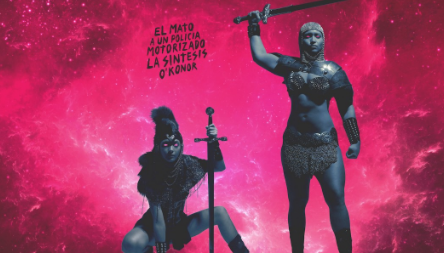
Juana Giaimo: Me acuerdo cuando tu amigo dijo que no le interesaba que Él Mató pase a la posteridad porque no es una banda con un mensaje social. Claro, “Paso todo el día pensando en vos” es demasiado pop. Y en la escena musical argentina, el pop es siempre menospreciado — a vos no te gusta que te hable de Taylor Swift o J. Balvin, lo sé. Pero a todos nos gustó la nueva sensibilidad melosa de La síntesis de O’Konor. Incluso en estos días de furia de verano, me sorprendo volviendo una y otra vez a “El tesoro.” Gracias a la producción pulida, las guitarras se entrelazan en armonía y el bajo en los versos actúa como una base acolchonada. Pero somos demasiado conscientes para olvidarnos de las injusticias y a veces nos consume esta vida de ciudad frenética. “Cuidarte siempre a vos en la derrota, hasta el final,” porque pareciera que siempre nos toca la derrota. Podría haber empezado a escuchar a Él Mató hace tanto tiempo, pero sólo necesité que vos mostraras en junio este sencillo para que se incorporaran a mi cotidianidad. No me hubiera interesado hace un año cuando escribía sobre Martha — una banda que se declara anarquista, cuyo lado político me costó ver más que el de Él Mató. Hace un año, sólo eran una banda de indie rock; no hubiera podido percibir la calidez de los suspiros o de la voz de Santiago Motorizado alzándose y descendiendo en los graves. Pero hoy todo es tan distinto que apenas me reconozco. “Ah, paso todo el día pensando en vos,” porque no se necesita decir más que eso.
[10]
Iain Mew: This summer I saw indie band British Sea Power in a big cold concrete space in the entrance to an old theme park in Kent. The venue felt remarkably right for the best of their music, with its heavily hewn guitar sounds and the airy calm and space they conjure between them. “El Tesoro” made me think back to that night, because El Mató a un Policía Motorizado use similar methods and a singer with impressive gravitas to achieve the same enjoyable isolating effect, but much brighter. I would love to see them in the same space in the sunshine.
[7]
Nortey Dowuona: Pedestrian drums, decorated by ornamental guitars and decorative synths that pulse above the head of Santiago Motorizado while a resounding but gimcrack bass runs underneath.
[6]
Alfred Soto: As the guitars get tangled like vines, Santiago Motorizado’s Argentinian-inflected Spanish summons Chris Martin for its vulnerability. It works. Better, though, is the way the track is allowed to breathe: marimba solo, synth solo, the guitars returning for more entanglement.
[7]
Ryo Miyauchi: He sings about providing protection like a soldier unwilling to leave his post. Despite the earnestness, though, I can’t quite hear it as admirable persistence but rather stubbornness. But got to give it to this band for meaning what they say: the rock music has got its feet planted, moving only slightly to give the floor to a frontman who equally won’t budge.
[5]
Edward Okulicz: The guitars are bright and the singer could project across canyons, perhaps continents. All the better to share his sadness.
[8]
Tim de Reuse: Snappy and bright, anchored by a to-and-fro clockwork rhythm and given color through lead singer Barrionuevo’s marvelous, swooping delivery. It’s interesting that such an upbeat song about unrequited affection ends with such a dark statement as “Es la depresión sin épica;” a “flat, everyday” depression that’s “so normal it’s part of your life,” according to Barrionuevo, who delivers the final two lines in a defeated, rhythmless mutter. It contextualizes the previous mentions of defeat, sinking treasure, and wasted time as consuming, space-filling concepts, larger than just items in an unfortunate circumstance. The “the end” of the chorus’s “until the end” might as well refer to the heat death of the universe — that’s how this kind of thing tends to feel when you’re in the thick of it.
[9]