Also ft. Marsha Ambrosius and H.E.R., among others…
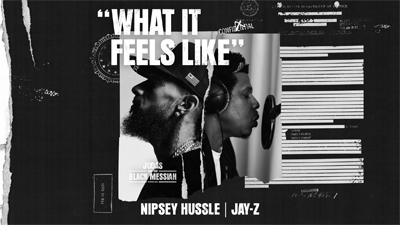
[Video]
[6.50]
John Seroff: Nipsey’s short and mostly unremarkable verse dates back to the early twentyteens, while Jay’s more labored and considered bars read stronger than they sound. Though the production is nice enough, nothing demands a replay. As a vehicle for funding two victims’ estates, I cant begrudge “What It Feels Like” any success, even if one can’t help but wonder what Fred Hampton would think of being serenaded by a billionaire “powered by blockchain technology.”
[5]
Thomas Inskeep: Crisp snares, plush synths, a sensational, topical Jay-Z verse (between 4:44, his appearances on Jay Electronica’s 2020 album, and this, he is focused these days), backing vocals from Marsha Ambrosius (!) and H.E.R. (!), and of course the late Nipsey (RIP): all of this adds up to what I absolutely want from hip hop these days.
[8]
Juana Giaimo: Maybe it’s because we’re too used to trap these days, but the straightforward hip-hop beat and that soulful track sound fresh. The chorus is quite monotonous, but I don’t mind it when the verses flow so easily.
[6]
Jacob Sujin Kuppermann: Expensive sounds courtesy of Mike & Keys and Larrance Dopson, but only Nipsey gets anything out of it– he gets to luxuriate in early career success, unburdened by the weight of being on a movie soundtrack. Jay seems all too aware of this– his verse kills the momentum of the track, shoehorning in political references in a blunt fashion that can’t hide the distance between his vision and the man he’s trying to put himself in the lineage of. The song ends up sounding best after he leaves, with the splendor of the beat getting to shine unadorned.
[5]
Alfred Soto: Stitching together a years-old Nipsey verse and a Jay-Z performance as fresh as last minute’s Twitter feed create tension and pathos: the aspirational bent of the former brushes against the clenched-teeth reality of the latter without curdling the track into an exercise in cynicism. His attitudes toughened by years of contact with powerful white men in expensive hotel suites, Jay can draw a line between his hustling days and the Capitol insurrection. The futility — the needlessness — of asserting an endangered ethnic identity that can only do so with violence, however, is all on white America.
[7]
Samson Savill de Jong: “If skills sold, truth be told, I’d probably be lyrically Talib Kweli.” Jay-Z is one of the most fascinating rappers in the game to me, a GOAT-level talent who by his own admission put making money over lyrical accomplishment. Rap’s full of sellouts and songs about getting paper above all else, but it’s rare for someone to brag that they compromised in order to get it. Jay raps above poverty and railed against the racism of the Grammys, but you’d struggle to find much politics in his actual music — until recently. Maybe it’s because he has no need to sell anymore, maybe because the way to sell is to be more lyrically adept and politically charged, maybe because his wife or wider circumstances have forced him to look beyond his own story, maybe because he grew up, maybe because of all of this and more. But this song represents the new Jay-Z of 4:44, not the Jay from The Blueprint or The Black Album, never mind the trash that was MCHG. Look at the Fred Hampton line, updated from the original, or how he’s updated his critique of systemic racism from hanging in the background to being very much in the foreground. None of this would matter for shit if Jay didn’t have the lyrics to back it up, but he absolutely does here. Post “retirement” Jay-Z has sometimes sounded bored/aloof, but he is focused here, with energy and lyricism. (“Scorpion bricks, way before Aubrey’s double disc//40 on my lap, clap, sound like 40 did the mix” is an incredible opening and he doesn’t really let off.) This is Jay-Z’s song, but Nipsey Hussle deserves a mention. I still don’t know how I feel about posthumous verses and songs (and we’re getting way too much experience with it at the moment) but that means that Nipsey’s verse, while pretty good standard brag rap, isn’t really relevant to the song or the film it’s inspired by (I feel like it was chosen purely because he mentioned Malcolm X). The beat sounds like something that would fit in on Untitled Unmastered, especially the extended outro, which appeals to me because I’m a sucker for such things. But Hova controls the song and demands attention before and after everything else. I really hope this represents what we’re going to get from now on.
[8]