How about a little art history?
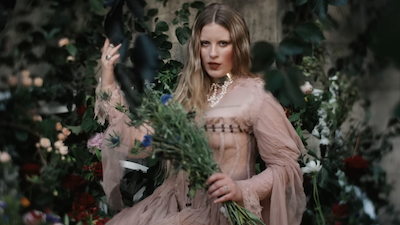
[Video]
[6.50]
[8]
Alfred Soto: She’s proud of her polysyllabic rhymes — is this the first instance of Dante Gabriel Rossetti given a hat tip in song? The string accompaniment and Paloma’s vocal tone are less frilly than the Pre-Raphaelite paintings I don’t care for.
[7]
Nortey Dowuona: Dante Rossetti is cited by Paloma in her first verse, dismissively regarded as “He didn’t have words like mine.” Rossetti was a poet as well as a painter, and his first painting, after cofounding the Pre-Raphaelites with John Everett Millais and William Holman Hunt, was The Girlhood of Mary Virgin, which used his mother, sister and family servant as models to depict the Virgin Mary with her mother and father, with a sonnet written into the frame of the painting as an explanation for the painting, marked with the Brotherhood’s initials, PRB. Paloma has written “I’m not a higher power, I just sit in the ceiling, cause I’m lonely on the fringes and it gives my life some meaning,” “leave me for a day or two, to make sure that turn blue, for the first time since I drew breath, I’m undesirable again,” (umm…well actually) and “for somebody who I thought was my saviour, you sure do make me do a whole lot of labour.” And here, she writes “And there was a time I was certain, I was sure, she grew straight from the earth on her pedestal, but here in the dirt, I know her better, I know her more, and I’d be subject to her laughter, if she ever did know.” Chills. Just saying, when Paloma starts painting, I’m going to go look straight at her paintings for 32 hours. She was fucking right.
[10]
James M Errington: The idea of Pre-Raphaelite pop music initially sounds interesting, but any interrogation of it reveals it to be less worth exploring. A rejection of modernism, a return to nature, sincerity, craft? If you can make that work, you’re a genius, and if you’re a genius, can’t you think of a better idea? In any case, Paris Paloma, I’m sorry to say, is not that genius. Instead, everything from her mannered fluttery indie girl voice to the swooping swings to the expensive Jack Antonoff style drum loops sounds like a carefully calculated cliché. To be fair, the lyrics are a bit more interesting, but it’s still just not enough.
[4]
Jel Bugle: Fairly generic mysterious goth girl song. Sounds a bit like trip hop, quite underwhelming, maybe the lyrics are important, like all lyrics they pass me by.
[5]
Tom Feckerdt: The name sounded familiar, and some cursory research revealed I totally recognize this woman from so many “all day everyday therapist mothermaid” Instagram reels I’ve gotten over the years. (Did you know that song almost charted?) Personally I get no kicks out of this type of quivering suburban-goth ‘alt’ style that’s been dominant since Florence and Aurora — to say nothing of Billie — so Paloma’s appeal to me is limited, and “Pre-Raphaelite” is no exception. I’ll welcome the thematic change of pace of a plain yearning anthem, encompassed in the song’s central and best line (“I make things but she’s made out of it.”) Certainly, being awed to such an extent you yourself feel intrinsically insufficient is a feeling immediately identifiable; for my own sake, I’d like to believe it’s universal. But the structural issues are the same ones as the rest of her catalog: every sonic element sanded over and grounded to the point of being suffocating. If you’re going to appropriate baroque aesthetics, that shit has to move, something that can’t happen with such blocky preset percussion and the harpsichord swells taking a backseat to “violins” that barely interact with anything else; no images spur into my mind. That applies to Paloma’s singing too, more subdued and ambiguous than usual. She does threaten to lose her cool for a brief moment in the final chorus adlibs, which makes me think it could be a vocal path worth pursuing — not that she’s doing too shabby without my help, of course.
[4]
Kayla Beardslee: That sure is a lot of words over an instrumental that’s already plenty busy! The bridge works because it finds time to pause before building back up, but the rest needs twice as much space to breathe.
[5]
Ian Mathers: The lyrics are actually kind of interesting! I just wish the melody, production, and performances were more so, instead of just “we have Florence and the Machine at home.”
[6]
Thomas Ruan: My first impression was “we have Florence + the Machine at home.” But I found more interesting details in the lyrics when I listened again. The way the images of hair tucked into a sweater and pink magnolia petals keep resurfacing, as if in a dream or even a memory of a dream, each time a little different. The phrase “out of it,” repeated in the chorus, multiplies in meanings. Paloma’s object of affection is “out of” memory, the painting she is compared to is made “out of” paint and canvas, in a way more alive than real life. But she is also trapped in that frame, and what we are left with now is Paloma singing from outside, “making things” in the hope that we can join her in the mists of her memories. For the length of the song, we can join her. Here we find another resonance of the play of inside and outside, where we as listeners are outside the experience conjured by the song, the web of references that draw us in with their specificity but also keep us at arm’s length in their dreamlike vagueness. There’s a lot going on here! So ultimately, I end up feeling a bit disappointed that I find the music itself so generic.
[6]
Katherine St. Asaph: Less Lizzie Siddal than Lizzy Grant, but anything that sounds this much like “Glory Box” (particularly toward the end) has a place in my world.
[7]
David Allun Jones: With enough flowery prose on display to trigger anyone’s hay fever, my initial half listen had me stamping both Paris Paloma and “Pre-Raphaelite” as dual Captains of Team Too Much. Following a quick deep dive to Paris’ prior discography — and the personal revelation that this has long been her vibe, such insta-judgement melted away with each re-spin. Amidst a witchy alt-pop sonic brew that twinkles in swirly orchestral decadence, “Pre-Raphaelite” utilizes Fiona & Florence-indebted warbles and wails to weave diaristic pangs of awe, infatuation and envy towards a female muse. It’s an endlessly fascinating peek into the unspoken thoughts women can have of each other, made even more impressive at the way it can succeed through a platonic or sexual lens. The meandering post-chorus business feels like a lost opportunity for punchier theatrics but still, paint me officially obsessed.
[9]
Jacob Sujin Kuppermann: Seems destined to go platinum on whatever remains of the Tumblr-fancam circuit. Art History 101 lyrics aside, this offers little in the way of interest; the harpsichord twinkles, Paloma delivers an appropriately swooning vocal performance, but nothing rises above the level of tastefully wan mood music.
[5]
Claire Davidson: If the title “Pre-Raphaelite” suggests pretension, Paris Paloma is well-equipped to dissuade listeners of that impression through aesthetic commitment alone: the track’s whimsical melody is stitched with a viola and accented with a harpsichord, and Paloma herself sings with the staid elegance of a practiced performer. The track’s subject matter is hardly unconventional: Paloma sings of a close friend who, thanks to both her otherworldly beauty and astonishing confidence, manages to magnify Paloma’s own insecurities with their every passing encounter. (One could easily mistake this song for a lesbian love ballad if it weren’t so tortured; indeed, Paloma sketches the relationship with such intimacy that her lyrics blur the bounds of mere platonic connection.) Yet the track is ornate enough to match Paloma’s rhapsodic poetry, surging with guitars on the second chorus and going full Florence Welch on the bridge, with Paloma unleashing a more booming vocal technique to convey the breadth of her angst. In fact, “Pre-Raphaelite” is so florid that its lyrics can approach purple prose, not helped by the jaunty meter of the verses, which can occasionally render Paloma’s words illegible. Less obvious, but no less important, is the track’s crackling percussion, whose paper-thin weight sounds borrowed from the laziest of lo-fi hip-hop beats, a bizarre contrast to the song’s otherwise resplendent grandeur. What counts, then, is the strength of Paloma’s passion, a frustration made so potent it manages to transcend these theatrical trappings and strike the listener’s heart with immediacy — a reminder that sonic frills are nothing without a driving force behind that glamour, a beating heart to match the vitality these details merely suggest.
[7]
Charlotte Gaze: I’m no sapphic, but I have a deep love for aesthetic, and in a way this song is more about the latter. For all the seductive dances and succulent pink flowers, the depth of the feeling is derived from the little details coming together to form a bigger picture, knit with stories, textures, colors, flaws and all. I can sense a mild intimidation beneath Paris Paloma’s adoration — for all she seeks to produce great works of art as part of her living, having one such work arrive in front of her, fully-formed, is the surest way to break through her composure and bring her frisson.
[8]